
Fatigue or Strategy? Using RSI-Mod to Pinpoint Performance Decrements
- Whistle Performance

- Feb 27
- 8 min read
In high-performance environments, Jump Height has historically been the "king" metric. However, Jump Height is an outcome measure—it tells you what happened, but not how it happened.
Two athletes can jump the exact same height using vastly different strategies. One might be explosive and spring-like, while the other might be slow and muscle-dominant. This is where the Modified Reactive Strength Index (RSI-Mod) becomes a valuable metric for practitioner’s to "look under the hood" of athletic performance.
When RSI-Mod drops, it is rarely a random fluctuation. It is a specific signal regarding an athlete’s neuromuscular status or movement strategy. Here is how to decode that signal to determine if your athlete is fatigued or simply moving inefficiently.

What is RSI-Mod?
RSI-Mod is a measure of jump efficiency. It is calculated by dividing Jump Height by Contraction Time (the total time spent generating force before takeoff).
RSI-Mod = Contraction Time / Jump Height
Because of this formula, a decrease in RSI-Mod is mathematically caused by one of two things:
1. Performance Decrement: The athlete didn’t jump as high.
2. Efficiency Loss: The athlete took longer to generate the force required to jump.
For over 40 years, Jump Height has reigned as the 'king' of performance metrics, largely because it was the only variable accessible to the masses through tools like Vertecs and Jump Mats. However, viewing Jump Height in isolation is akin to judging a race car solely by its finish time without inspecting the engine; it provides the outcome of the movement, but completely ignores the strategy used to achieve it. While Jump Height answers the question 'how high?', it fails to answer the critical questions of 'how efficient?', 'how fast?', and 'at what cost?'—blind spots that can obscure fatigue, mask injury risk, and hide the true differentiators of elite performance."

With regards to Jump Height -> Here is the step-by-step breakdown of how it works:
1. The "Chain of Events"
To explain jump height accurately, you must work backward from the result to the cause:
• Height depends on Velocity: How high an athlete displaces their center of mass is strictly determined by their Takeoff Velocity (how fast they are moving the moment they leave the ground).
• Velocity depends on Impulse: How fast they can move their mass is determined by the Concentric/Propulsive Net Impulse they generate.
• Impulse depends on Transfer: The ability to generate that propulsive/concentric impulse relies on successfully transferring momentum generated during the Braking/Eccentric Phase (the descent).
2. The Physics: Impulse-Momentum
The most accurate calculation of jump height uses the Impulse-Momentum theorem.
• The Formula: Impulse is defined as Force x Time (the area under the force-time curve).
• Net Impulse: To jump, an athlete must produce force greater than their own body weight. "Net Impulse" is the calculation of that extra force multiplied by the duration it is applied.
• The Outcome: Because the athlete's body mass is constant, the only way to increase takeoff velocity (and therefore jump height) is to increase that Concentric/Propulsive Net Impulse.
3. Why This Explanation is Superior (Impulse vs. Flight Time)
Explaining jump height via Impulse (Takeoff Velocity) is considered the "gold standard" over Flight Time for two specific reasons:
• Cheating the Metric: Flight time calculations can be manipulated. If an athlete tucks their knees up mid-air (increasing hip flexion), they delay their landing. This artificially increases flight time and "overestimates" jump height without actually displacing their center of mass any higher.
• Cause vs. Effect: Flight time is just an outcome measure. Calculating height via impulse allows practitioners to look "under the hood" at the "engine" (force and time) that drove the athlete upward, providing actionable data on how the jump was created rather than just what the result was.

While Jump Height remains the headline metric for performance output, Contraction Time (or time to takeoff) acts as the critical diagnostic tool that reveals the efficiency and strategy behind that output. Biomechanically, athletes can achieve the same jump height by either producing high force quickly or by applying lower force over a longer duration; however, in the presence of neuromuscular fatigue, athletes often subconsciously adopt the latter strategy—squatting deeper or moving slower to artificially extend the contraction time. By lengthening the time available to generate Concentric/Propulsive Net Impulse, a fatigued athlete can mask deficits in explosive power and maintain their standard jump height, making Contraction Time (and derived metrics like RSI-Modified) a far more sensitive early warning system for mechanical inefficiency and residual fatigue than output metrics alone.


Eccentric Duration: The "Braking" Indicator
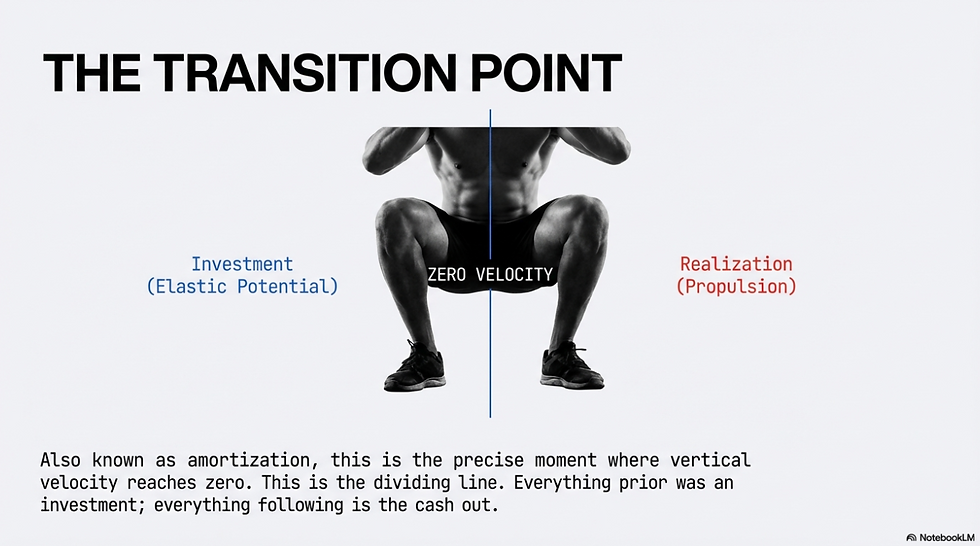
Elongation of the eccentric phase is a primary indicator that the athlete’s ability to decelerate is compromised.
• Poor Braking Ability: The Eccentric Deceleration/Braking Phase (the very bottom of the dip) is highly sensitive to load. If this phase gets longer, it indicates the athlete’s "brakes" are failing—they lack the eccentric stiffness or neural drive to stop their downward momentum instantly, resulting in a "soft" or slow turnaround.
• Increased Depth: Fatigued athletes often increase their Countermovement Depth to give themselves more time to generate force. This mechanically forces the Eccentric Duration to increase.

Concentric Duration: The "Grind" Indicator
An increase in concentric duration reveals a loss of explosiveness.
• "Grinding" the Jump: If the concentric phase elongates, the athlete is likely relying on a "force-dominant" strategy—muscling the jump up slowly ("grinding") rather than relying on the efficient, snap-like transfer of elastic energy.
• Bimodal Force Trace: A longer concentric phase is often accompanied by a bimodal force trace (two distinct peaks). This "m" shape indicates a stutter in force production, signaling that the athlete failed to transfer energy efficiently from the eccentric to the concentric phase, a common result of fatigue or poor sequencing.
Summary: Why the Breakdown Matters
Breaking down Contraction Time allows you to pinpoint the specific mechanical failure caused by fatigue:


By monitoring the length of the eccentric phase, coaches can determine if an individual has lost the ability to decelerate effectively. Conversely, a prolonged concentric phase suggests a lack of explosive power during the upward push. Even when an athlete maintains their typical jump height, a slower overall movement indicates they are using compensatory strategies to mask exhaustion. Ultimately, these biometric markers serve as a diagnostic tool to identify whether an athlete is performing efficiently or struggling to manage their physical output.
RSI-Modified (RSI-Mod) measures mechanical efficiency by dividing Jump Height by—the physical result of Concentric/Propulsive Net Impulse—by Contraction Time, which effectively represents the "cost" paid to generate that force. Countermovement Jump (CMJ) depth acts as a specific lever for time in this equation; squatting deeper mechanically extends the duration of force application, which increases the denominator and drastically lowers the final RSI-Mod score. While certain athletes often resort to this "time-dominant" strategy when fatigued—subconsciously increasing depth to buy more time to generate impulse because they lack explosive power—this metric requires careful interpretation in rehabilitation contexts along with looking at how this variable changes overtime vs subjects 'baseline'.
The provided text explains the mechanical relationship between jump mechanics, force production, and efficiency metrics like RSI-Modified.
This metric evaluates performance by comparing the height achieved during a jump against the time required to generate that upward momentum. While a shallow, explosive movement typically yields a superior value, athletes often subconsciously increase countermovement depth to compensate for fatigue or a lack of power. This strategy allows for more time to build impulse, yet it simultaneously lowers the efficiency rating because the movement becomes slower and more labored. Interestingly, while increased depth usually signals poor performance, it can represent positive progress in rehabilitation by showing an athlete’s renewed ability to handle physical loads. Ultimately, jump height alone does not tell the full story of an athlete’s neuromuscular readiness or recovery status.


1. The Core Equation
RSI-Mod is calculated as Jump Height divided by Contraction Time.
• Jump Height is the physical result of Propulsive Net Impulse (how much force is applied to push the body off the ground),.
• Contraction Time is the "cost" paid to generate that impulse.
2. How CMJ Depth Impacts RSI-Mod
CMJ Depth acts as a lever for Time. Altering depth changes the duration available to generate force.
• Increased Depth = Increased Time: A deeper squat increases the distance the athlete travels down and back up. This mechanically extends the Contraction Time.
• The Efficiency Drop: While squatting deeper allows the athlete to apply force over a longer distance (potentially maintaining Jump Height), the increase in time is often disproportionately large. Mathematically, increasing the denominator (Time) drastically reduces the RSI-Mod score.
• Fatigue Strategy: In healthy athletes, an unexpected increase in CMJ Depth is often a "cheat" strategy. The athlete is fatigued and lacks explosive power, so they subconsciously squat deeper to buy more time to generate the necessary impulse to hit their standard jump height.

3. How Impulse Impacts RSI-Mod
Impulse is defined as Force multiplied by Time (the area under the force curve). There are two ways to generate enough impulse to jump high, and they have opposite effects on RSI-Mod:

• Strategy A: Force-Dominant (High RSI-Mod)
◦ The athlete generates a massive amount of force in a very short time.
◦ Result: High Impulse (good height) + Low Time = High RSI-Mod. This indicates a "stiff" or explosive strategy.

• Strategy B: Time-Dominant (Low RSI-Mod)
◦ The athlete lacks the ability to produce high force quickly, so they extend the duration of the push (often by increasing depth) to accumulate the same total impulse.

◦ Result: High Impulse (good height) + High Time = Low RSI-Mod. This is described as "grinding" the jump.
4. The "Impulse-Depth" Paradox in Rehab
While a drop in RSI-Mod due to increased depth and impulse time is usually a negative sign in performance monitoring (indicating fatigue or inefficiency), it can be a positive signal in rehabilitation (e.g., ACL reconstruction).
• The Context: Injured athletes often protect their knee by using a stiff, shallow jump (low depth, short time). This might artificially inflate RSI-Mod or make them appear "explosive."
• The Insight: If a rebounding athlete increases their CMJ Depth, they are showing a willingness to accept load through greater knee flexion. Even if their RSI-Mod drops (because contraction time increased), this increase in depth and impulse duration represents restored confidence and functional capacity.

Conclusion
Ultimately, the Modified Reactive Strength Index (RSI-Mod) serves as the critical "efficiency rating" for athletic movement, revealing the hidden mechanical cost of performance. A drop in this metric is rarely a random fluctuation; rather, it is a specific signal that the athlete is either losing power or, more commonly, altering their movement strategy to compensate for neuromuscular fatigue. By adhering to a structured diagnostic workflow—moving beyond Jump Height to inspect Contraction Time, Countermovement Depth, and specific Eccentric Deceleration qualities—practitioners can distinguish between a true loss of output and a "false recovery" where the athlete maintains height by subconsciously "cheating" the mechanics. This deeper level of analysis transforms force plate data from simple output monitoring into a decision-making tool, allowing coaches to target the specific root cause of the decline—whether it be braking inefficiency, poor force transfer, or the immediate need for recovery.


Journal Articles
• Kennedy, R. A., & Drake, D. (2017). The effect of acute fatigue on countermovement jump performance in rugby union players during preseason. The Journal of Sports Medicine and Physical Fitness, 57(10), 1261–1266. https://doi.org/10.23736/S0022-4707.17.06848-7
• Talpey, S. W., Haintz, L., Drake, M., Mundy, P. M., Rayner, R., James, L. P., O’Grady, M., Gabbett, T. J., & Gardner, E. C. (2025). The utility of the countermovement rebound jump for the assessment of neuromuscular status in National Collegiate Athletic Association Division I American football players. Journal of Strength and Conditioning Research. Advance online publication.
eBooks & Practitioner Guides
• Bell, K., & Berberet, D. (n.d.). The Countermovement Jump Playbook (Vol. 1). Hawkin Dynamics.
• McLaughlin, R., Cohen, D., Graham-Smith, P., James, L., & Natera, A. (n.d.). Practitioner’s Advanced Guide to Force Plates. VALD Performance.
• VALD Performance. (n.d.). Practitioner’s Intermediate Guide to Force Plates.
• VALD Performance. (n.d.). Practitioner’s Guide to Force Plates (Vol. 1).
Online Articles & Blogs
• Virgile, A. (2020, November 9). A review of 100 jumps: Is there an optimal force profile for the CMJ? Hawkin Dynamics. https://www.hawkindynamics.com/blog
Internal Documents/Workflows
• The RSI-Mod Diagnostic Workflow. [Unpublished internal document].
• Optimizing Force Plate Metrics and Vertical Jump Performance. [Unpublished internal document].
Comments