
October 5, 2026
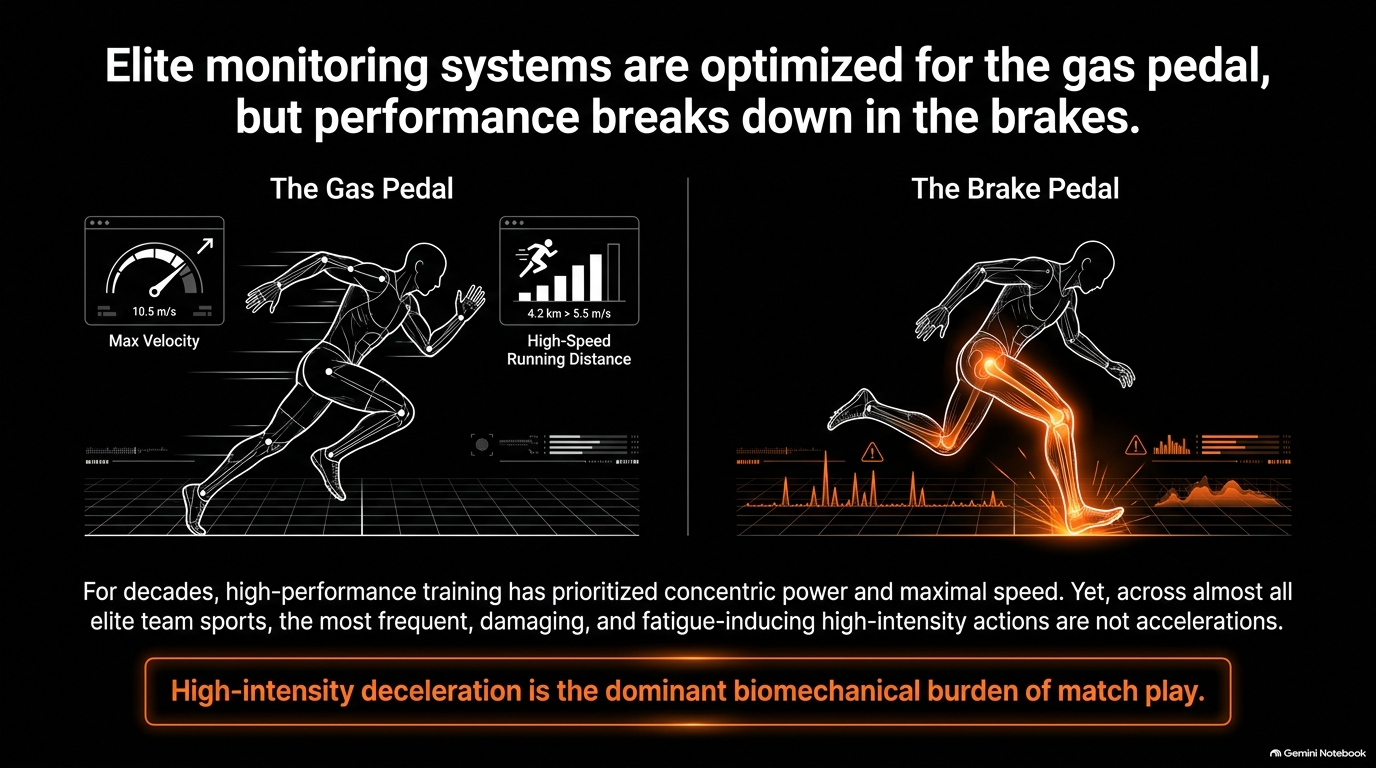
In the modern era of elite team sports, wearable microtechnology—most notably Global Positioning System tracking units—has revolutionized how performance staff evaluate player movement profiles and match loads. Coaches routinely track distance, high-speed running, and sprint efforts. However, some of the most physically demanding actions on the field occur when athletes rapidly change speed.
To bring clarity to these movement demands, researchers Damian J. Harper, Christopher Carling, and John Kiely conducted a landmark meta-analysis titled "High-Intensity Acceleration and Deceleration Demands in Elite Team Sports Competitive Match Play: A Systematic Review and Meta-Analysis of Observational Studies."
While accelerations carry high metabolic costs, high-intensity decelerations generate severe mechanical and eccentric loads. These braking efforts frequently trigger soft-tissue microtrauma, neuromuscular fatigue, and elevated injury risk. The authors undertook this systematic review to quantify these intense speed changes across diverse sports, examine how fatigue impacts output across match halves, evaluate methodological inconsistencies in tracking technology, and equip performance staff with practical loading strategies.
Study Results: The Reality of Match Demands
The meta-analysis synthesized data across nineteen observational studies covering seven elite team sports—including soccer, rugby union, rugby league, rugby sevens, Australian football, hockey, and American football—evaluating four hundred sixty-nine elite male athletes.
For strength and conditioning coaches, sports scientists, and medical staff, these findings carry profound implications for training design, injury prevention, and load management.
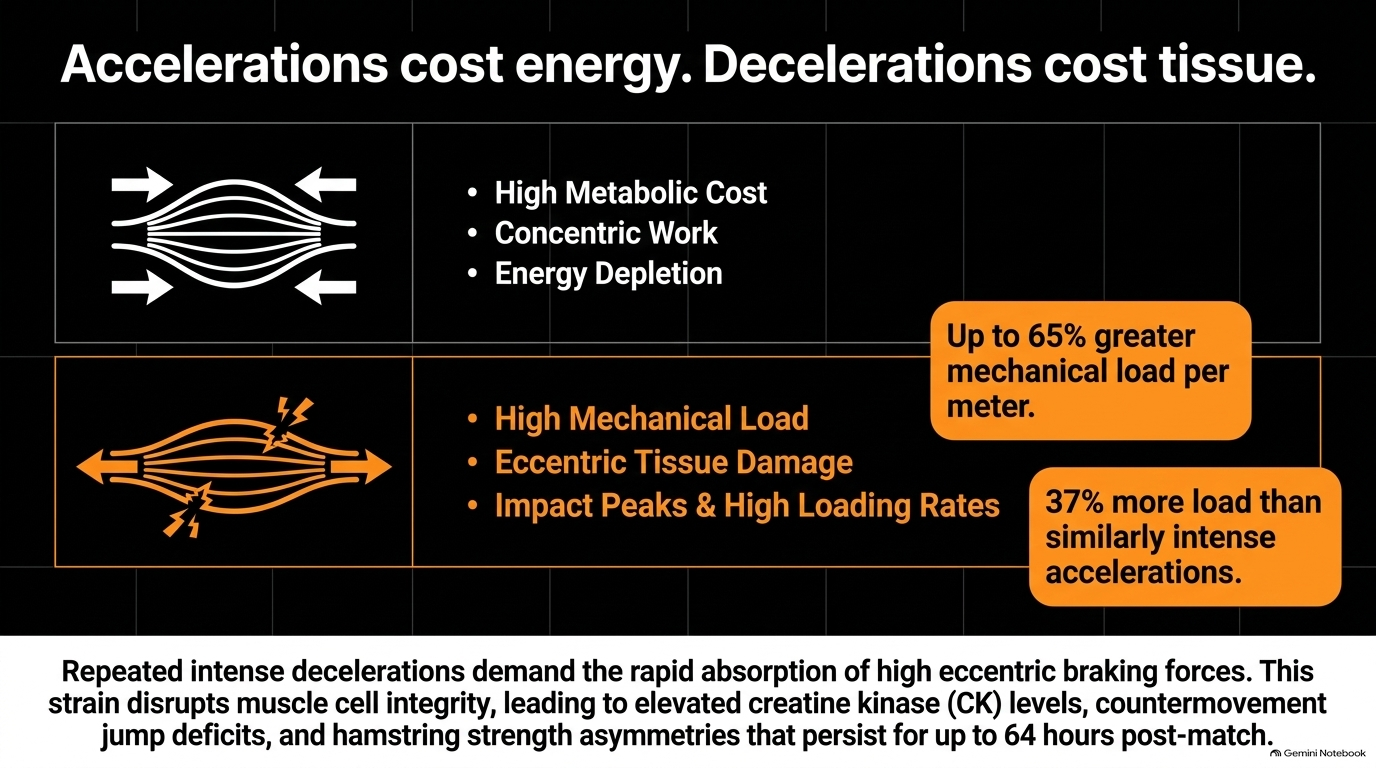
High-intensity decelerations generate up to sixty-five percent higher mechanical load per meter than any other match activity and thirty-seven percent more than accelerations. These repeated braking forces induce exercise-induced muscle damage, impair the rate of force development, reduce vertical jump power, and cause persistent hamstring strength deficits that can linger for up to sixty-four hours post-match.
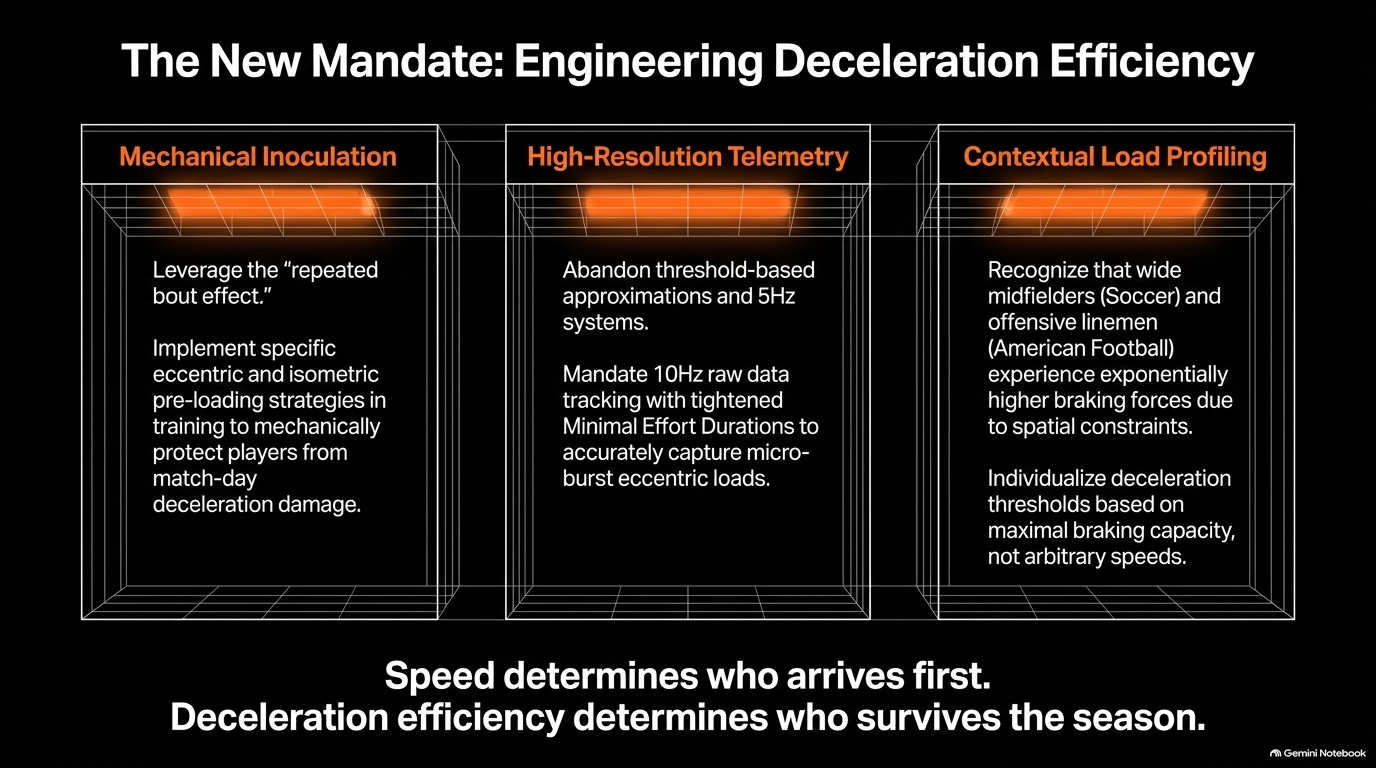
Performance staff must regularly incorporate targeted eccentric and isometric strength training to build muscle-tendon resilience. Pre-conditioning athletes through structured eccentric loading leverages the repeated bout effect, shielding tissue against match-induced damage and enhancing deceleration efficiency.
Generic, team-wide speed programs are insufficient. Training must reflect position-specific deceleration profiles:
Unmanaged spikes in high-intensity deceleration volume represent a major risk factor for chronic soft-tissue injuries and joint overuse. Performance teams should track deceleration volume as a standalone metric alongside total distance and high-speed running. Microcycles must be periodized to avoid sudden acute spikes while maintaining sufficient chronic exposure to preserve protective adaptations.
To ensure data reliability, practitioners should implement standardized minimal effort duration criteria and filtering settings within their tracking software. Establishing robust normative player profiles requires capturing data across at least ten competitive matches. Furthermore, practitioners should transition away from rigid, arbitrary acceleration thresholds toward individualized thresholds based on an athlete's maximal physical capabilities, while contextualizing tracking data with video analysis of tactical movements.
-------------------------------------------------------------------------------------------------------------------------------------
Article Reference
Harper, D. J., Carling, C., & Kiely, J. (2019). High-intensity acceleration and deceleration demands in elite team sports competitive match play: A systematic review and meta-analysis of observational studies.Sports Medicine, 49(12), 1923–1947.