
June 1, 2026

The Stopwatch Illusion: Why Sprint Momentum is the True Measure of Athletic Dominance
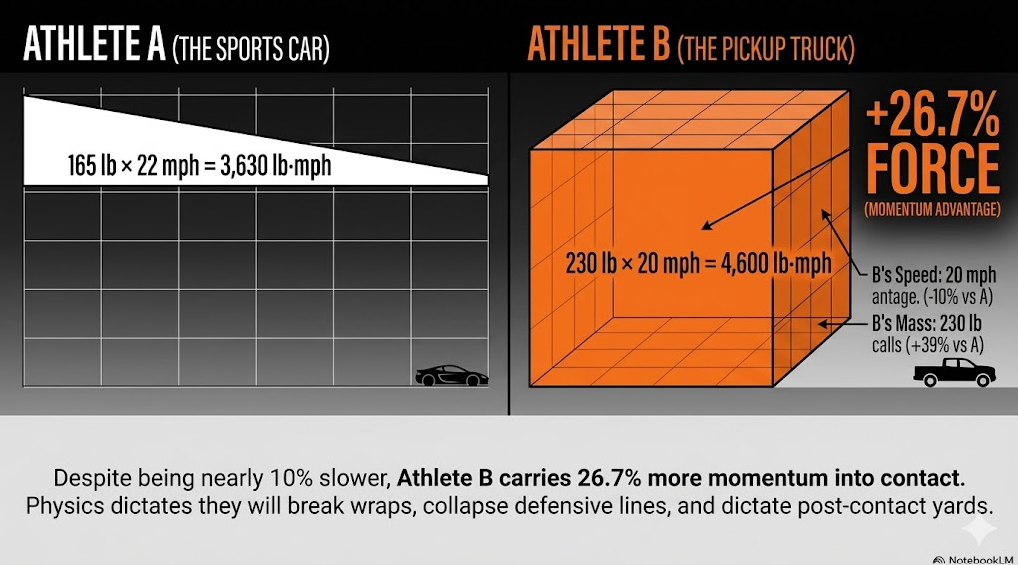
Imagine two athletes breaking down the sideline, entirely untracked by defenders. Athlete A is a lightning-fast, 165 lb winger clocking a blazing maximal sprint speed of 22 mph. Athlete B is a bruising, 230 lb powerhouse tracking down the opposite flank at 20 mph. If your scouting department strictly relies on the raw stopwatch or linear GPS rankings, Athlete A wins every single time. But collision sports like rugby, rugby league, and American football do not take place on a track or a spreadsheet. Eventually, the space closes down, and the athlete must meet an opposing defender at the point of impact. This is the "stopwatch illusion," where traditional speed metrics completely break down. The fastest athlete isn't automatically the most dangerous; the most dangerous athlete brings the most devastating combination of velocity and structural mass to the collision. To understand true on-field power, elite programs are abandoning raw velocity and prioritizing a far more diagnostic metric: Sprint Momentum.

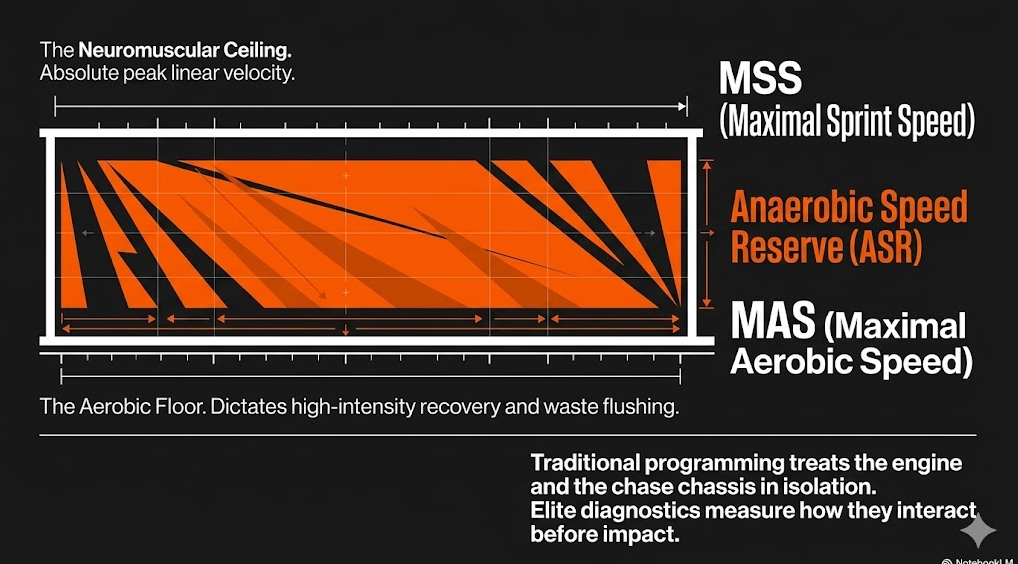
To understand why isolated speed metrics fall short, sports scientists first map an athlete's physical capacities using a digital dashboard known as the Locomotor Profile. This telemetry system outlines the blueprint of an athlete's internal machine by establishing two critical physiological boundaries: the Maximal Aerobic Speed (MAS) and the Maximal Sprint Speed (MSS). MAS acts as the "Aerobic Floor" or the "engine," dictating how efficiently an athlete recovers, flushes metabolic waste, and sustains efforts across a match. MSS serves as the "Neuromuscular Ceiling" or the "chassis," representing the absolute peak linear velocity an athlete can physically reach. When you need an athlete to exert absolute dominance in a dynamic tackle or post-play collision, measuring the interaction of this engine and chassis generates a critical diagnostic output: Sprint Momentum.
Sprint momentum strips away the abstract concept of raw "speed" and evaluates the literal kinetic energy an athlete carries through space. It relies on a straightforward Newtonian formula: Sprint Momentum (lb·mph) = Body Mass (lb) × Maximal Sprint Speed (mph). Returning to our opening scenario, Athlete A (the 165 lb winger) is like a high-end, lightweight sports car, generating a sprint momentum of 3,630 lb·mph. Athlete B (the 230 lb powerhouse) is like a mid-sized pickup truck. Despite being nearly 10% slower in absolute velocity, the powerhouse's immense structural mass generates a sprint momentum of 4,600 lb·mph. The "truck" carries over 26% more total momentum into the point of contact, requiring vastly more breaking force from the opposition to bring to a halt. This structural advantage directly translates into dominant tackles, broken wraps, and post-contact yards.
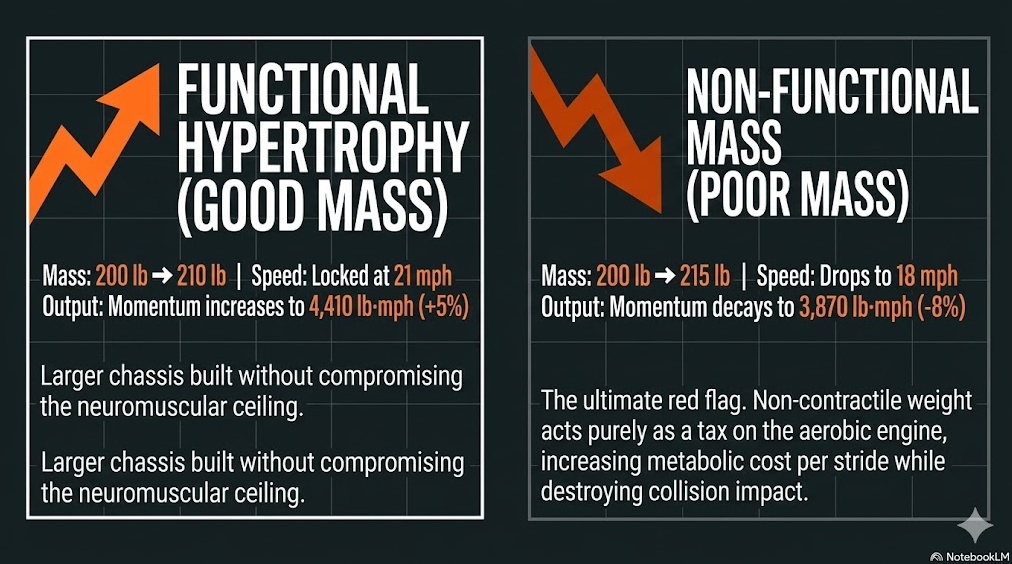
However, because mass acts as a direct multiplier in this equation, coaches frequently make the catastrophic mistake of assuming that any weight gained on the scale is positive. Tracking sprint momentum serves as an immediate "truth serum" for strength and conditioning programs, distinguishing between two radically different physiological adaptations. Functional Hypertrophy (Good Mass) occurs when an athlete adds lean muscle tissue while successfully maintaining or improving their velocity. For instance, if an athlete bulks from 200 lb to 210 lb while keeping their top speed locked at 21 mph, their sprint momentum efficiently scales upward from 4,200 lb·mph to 4,410 lb·mph.
Conversely, Non-Functional Mass (Poor Mass) is the ultimate red flag. If an athlete aggressively bulks up to 215 lb, but the non-contractile weight causes their top-end speed to decay from 21 mph to 18 mph, their actual sprint momentum drops by nearly 8% to 3,870 lb·mph. They are now carrying a metabolic tax that prematurely pushes them into anaerobic distress and makes them mathematically less powerful at the moment of collision.
This physical reality is heavily verified by longitudinal, peer-reviewed data. A 2008 study by sports scientists Dan Baker and Robert Newton compared the lower-body strength, power, and sprint momentum of professional rugby league players across various competitive ranks. The researchers discovered that as players progressed from regional academy prospects up to elite senior professionals, their absolute maximal sprint speed (MSS) did not drastically change, as neuromuscular ceilings typically hit a hard biological limit in an athlete's early twenties. What statistically separated the elite senior squads from the 19-year-old prospects was their sprint momentum. Senior players had spent years systematically building dense, lean mass while protecting their velocity ceilings. The data revealed a massive correlation (r=0.84 to 0.92) between an athlete's sprint momentum metrics and their competitive selection rank.
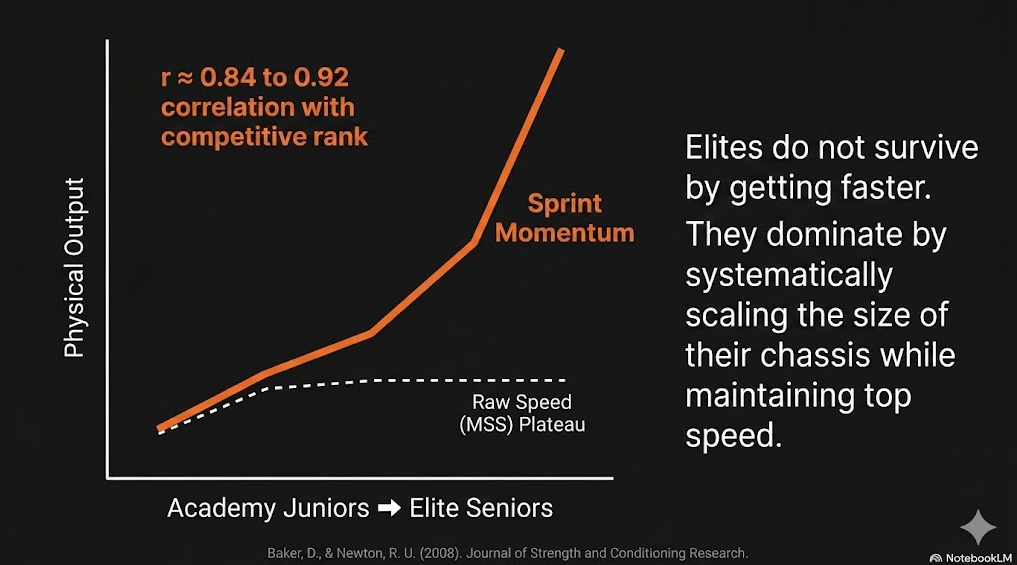
In the high-stakes environment of elite collision sports, surviving and dominating requires far more than just genetic quickness. Raw speed might secure an academy trial, but the literal physics of the field dictate that the size of the chassis must scale alongside it. The core takeaway for high-performance coaches is simple: stop tracking just the stopwatch, and stop tracking just the scale in the locker room. Focus instead on the total force moving down the field. If your athletes are gaining weight but their momentum numbers aren't climbing, it is time to overhaul your performance programming.