

July 6, 2026

If you’ve spent any time coaching team sports, you’ve likely witnessed a frustrating phenomenon: your fittest player on paper—the one who dominates the steady-state 5K or the continuous track laps—suddenly looks completely gassed by the second half of a chaotic, high-intensity game.
Why the disconnect? Because traditional fitness tests are lying to you about your athletes’ actual game readiness.
Welcome to Part 1 of our 4-part masterclass on the 30-15 Intermittent Fitness Test (30-15IFT). Over this series, we are going to break down why this test has completely revolutionized sports science, who should be using it, how to program intervals with it, and exactly how to run it with your team.
Today, we are diving into the history, the broken testing culture that preceded it, and the deep science of why it works.
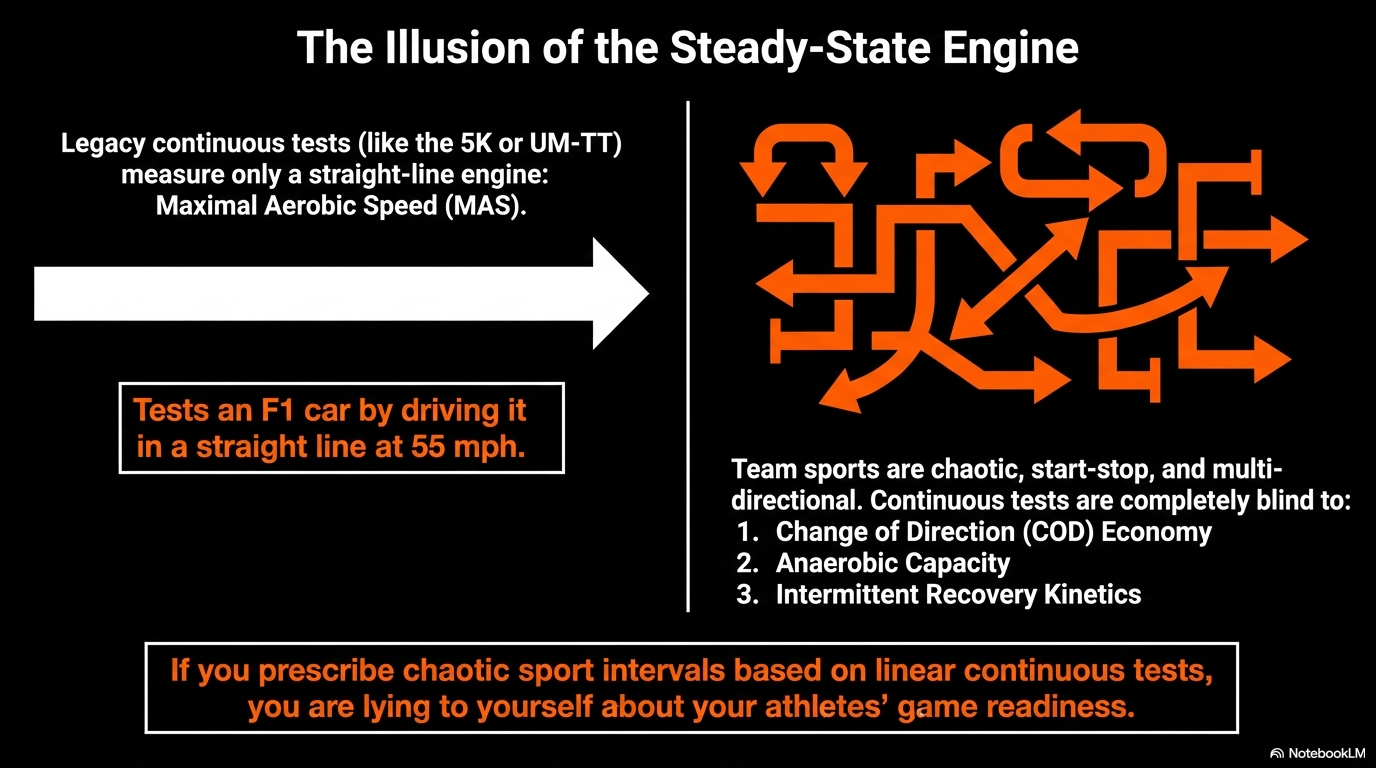
For decades, the sports science world relied on continuous or linear tests to measure cardiovascular fitness. Tests like the Cooper 12-minute run, standard Maximal Aerobic Speed (MAS) straight-line time trials, or even the classic multi-stage 20-meter "Beep Test" were the gold standards.
But team sports—like soccer, basketball, rugby, and handball—are not linear or continuous. They are chaotic, start-stop, and multi-directional.
When you force an athlete to run a continuous test, you are only measuring their Maximal Aerobic Speed (MAS). You are completely blinding yourself to three massive components of team sport performance:
Using a continuous test to measure a field athlete is like testing a Formula 1 car's performance by driving it in a straight line at 55 mph. It misses the point entirely.
In the early 2000s, French sports scientist and performance coach Dr. Martin Buchheit was working with elite handball players. He grew deeply frustrated with the limitations of existing field tests. Traditional tests either failed to simulate the physical demands of court sports or failed to give coaches actionable data to design high-intensity intervals.
In 2005, Buchheit published a groundbreaking paper in Approches du Handball, introducing a new protocol: the 30-15 Intermittent Fitness Test.
Instead of running until you drop without stopping, Buchheit introduced a distinct, intermittent structure:
The test starts at a comfortable $8.0 \text{ km/h}$ and increases by $0.5 \text{ km/h}$ with every subsequent 45-second stage (work + rest).
To account for the immense energy it takes to slow down and turn around, the test is performed as a shuttle run across a 40-meter zone, split into distinct markers. Buchheit even factored in the exact mathematical energy cost of turning around—calculating that every single change of direction adds roughly a $0.7\text{-second}$ tax on the athlete's pacing schedule.
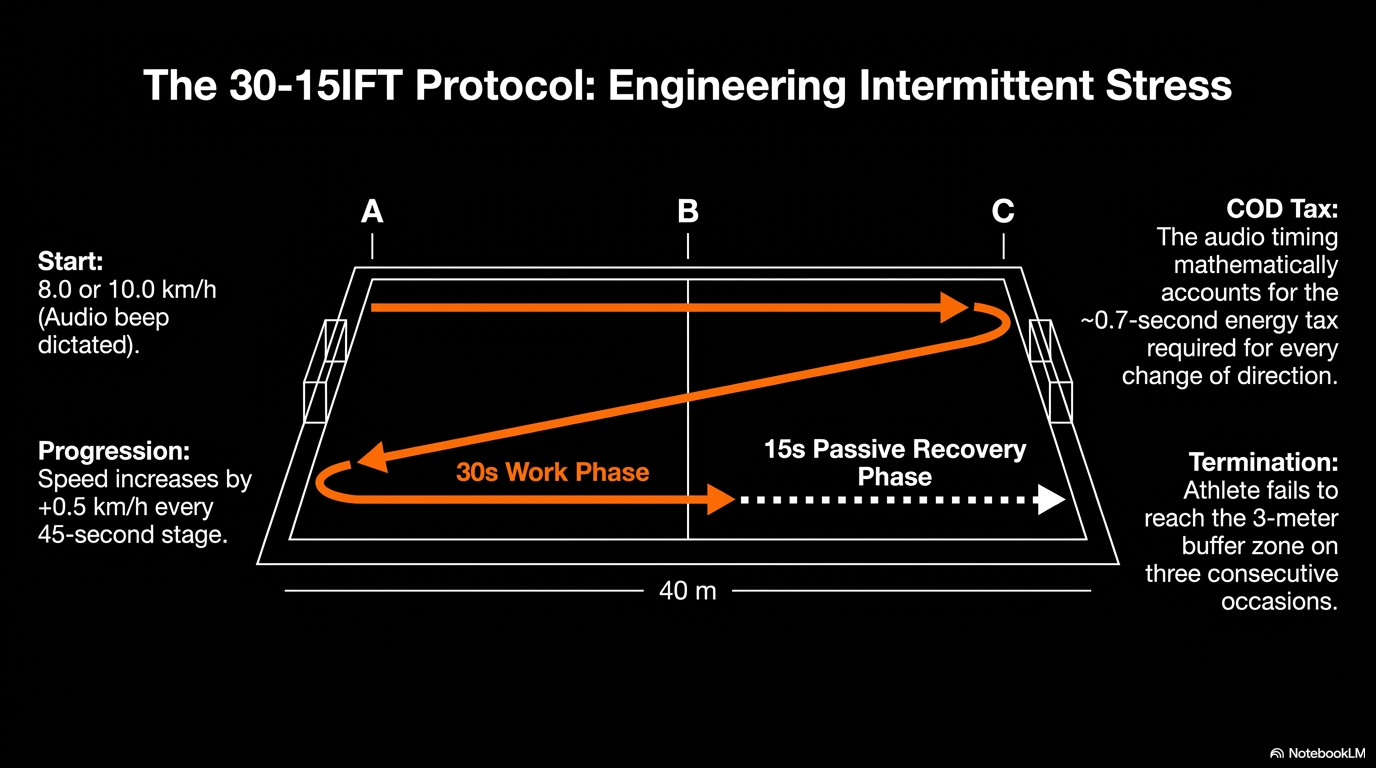
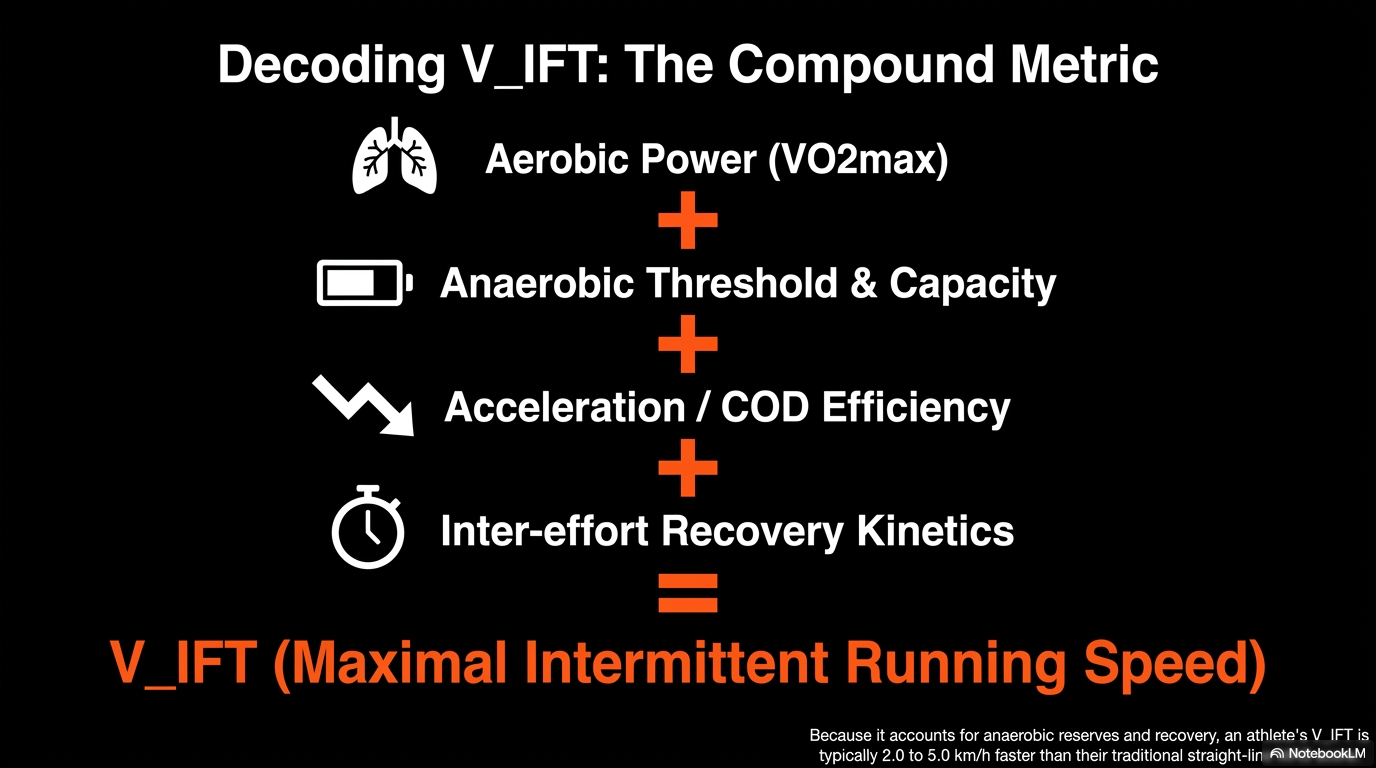
When an athlete finally reaches exhaustion and can no longer match the audio beeps, their final completed stage dictates their score. This score isn't measured in VO2max or time; it is measured in velocity, known as V_IFT (Velocity of the 30-15 Intermittent Fitness Test).
V_IFT is a "compound metric." It is not a clean, isolated measure of aerobic capacity. Instead, it is a messy, beautiful reflection of real-world sports performance. Your V_IFT score is a combined cocktail of your:
Because the 15-second rest periods are completely insufficient to fully recover, the body is forced into a state of cumulative, incomplete clearance. Your anaerobic system handles the intense 30-second bursts, while your aerobic system frantically tries to recharge the battery during the brief 15-second walk.
Research shows that by the final stages of the test, athletes are spending upwards of 2 to 3 minutes operating at over 90% of their maximal oxygen uptake. It pushes the cardiorespiratory and metabolic systems to their absolute limits.
.png)
Now that you understand the science and the history behind why this test was created, it's time to figure out if it belongs in your specific program. In Part 2: Who is the 30-15IFT For? (And Who Should Skip It), we will break down exactly which sports, ages, and competitive levels benefit most from this protocol, and pinpoint the exact scenarios where you should absolutely choose a different test.
Stay tuned.
References