
June 8, 2026

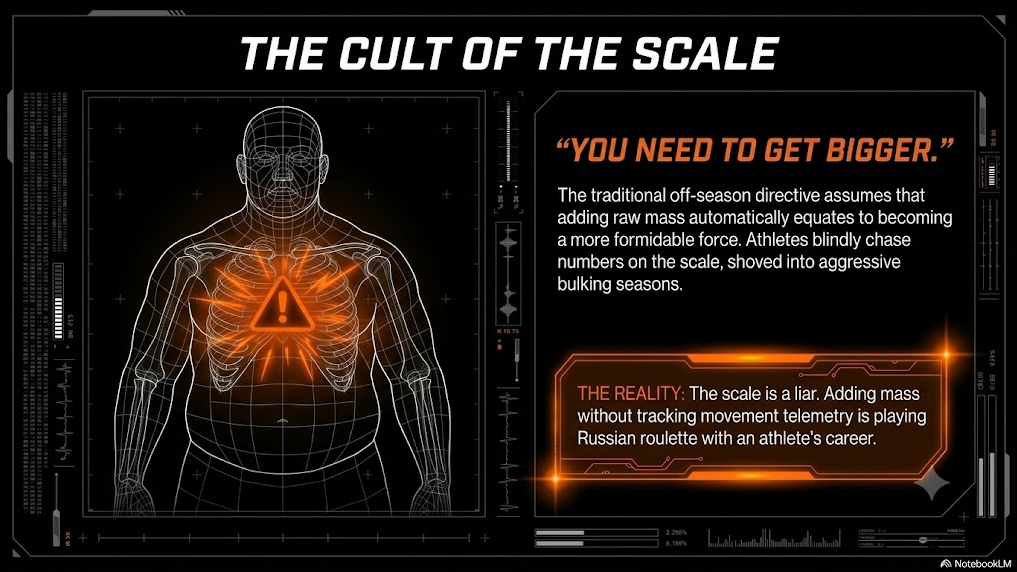
Walk into almost any high school, college, or semi-professional weight room during the offseason, and you will hear the exact same directive echoing off the walls: "You need to get bigger".
We’ve all seen it—the hyper-aggressive "bulking season." Athletes blindly chase a higher number on the scale, shoveling down calories and grinding through heavy lifts under the assumption that raw mass automatically translates to dominance on the field.
But here is the cold, hard reality of sports science: the scale is a liar.
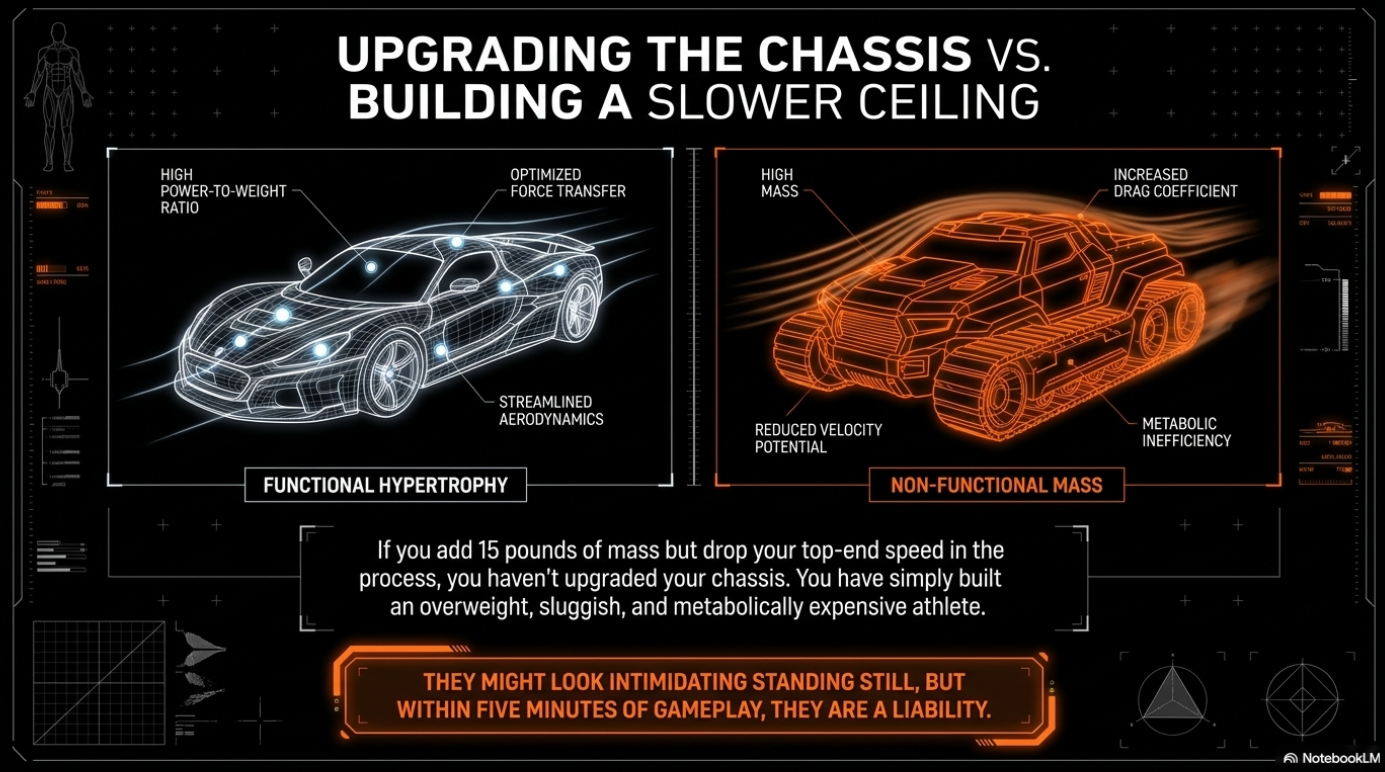
When athletes pack on weight without tracking how that weight impacts their movement, they are playing Russian roulette with their careers. An unmonitored bulk rarely builds a powerhouse; more often than not, it builds an overweight, sluggish, and metabolically expensive athlete who completely gasses out by the end of the first quarter. If you add 15 pounds of mass but drop your top-end speed, you haven’t upgraded your engine—you’ve just built a slower ceiling.

The Gas Tank: Understanding Anaerobic Speed Reserve (ASR)
To understand why "bulking" often backfires, we have to look at the physiological buffer that dictates high-intensity running: the Anaerobic Speed Reserve (ASR).
Think of your athlete's performance capacity as a room. The floor is their Maximal Aerobic Speed (MAS)—their baseline aerobic capacity. The ceiling is their Maximal Sprint Speed (MSS)—their absolute neuromuscular speed limit.
The space between that floor and that ceiling is the ASR. This is a highly volatile, high-octane performance buffer. Every single time an athlete sprints, cuts, or pushes past their aerobic floor, they are pulling directly from this anaerobic reserve.
This is why traditional, blanket conditioning rules—like telling the whole team to run at "120% of their MAS"—are flawed. A natural, lightweight speedster with a massive ceiling will find that run incredibly easy, while a heavier powerhouse might be pushed to their absolute biological breaking point. By tailoring conditioning to an athlete's specific ASR, we can ensure the heavy linebacker and the lightweight winger experience the exact same relative strain.

The Metabolic Tax of "Dead Weight"
So, what happens to this delicate ASR buffer when an athlete packs on the wrong kind of mass?
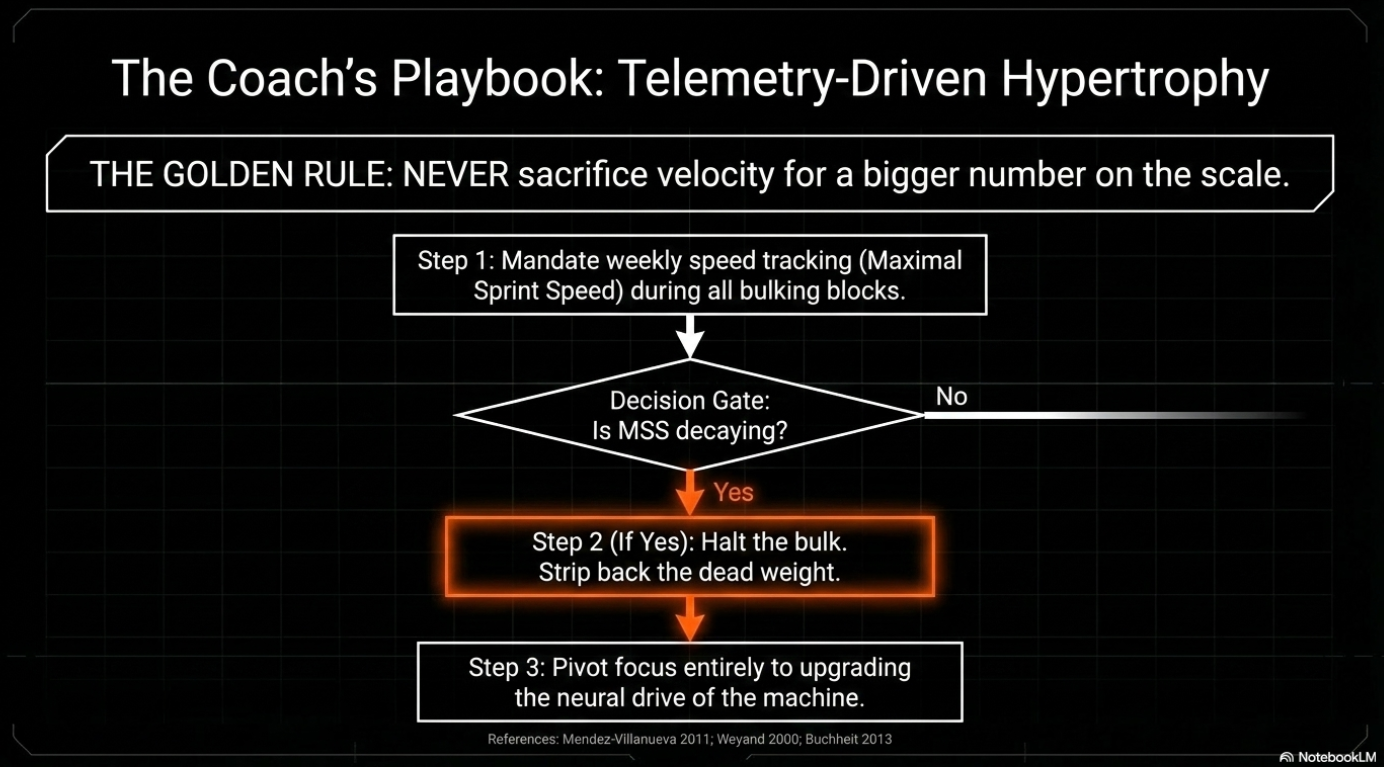
Every single pound of weight added to an athlete's frame that doesn't directly contribute to force production acts as a strict metabolic tax. When an athlete gets heavier and slower, their MSS ceiling comes crashing down toward their MAS floor.
As that ceiling collapses, their total Anaerobic Speed Reserve drastically shrinks, throwing them into what sports scientists call The Red Zone of Anaerobic Distress. Suddenly, the physiological cost of every single sprint skyrockets. A sub-maximal jog that used to cost them 50% of their energy reserve now drains 80% to 90% of their max effort.
The on-field consequence is immediate. Your athlete is in constant anaerobic distress, accumulating metabolic waste faster than their body can clear it. They might look absolutely terrifying standing still on the sidelines, but within five minutes of game time, they are dragging an unathletic chassis around the field and becoming a massive liability.
The Biomechanics: Why Big Muscles Equal Slow Feet
Why exactly does adding the wrong kind of mass pull down an athlete's top-end speed? The answer lies in the biomechanics of mass-specific force.
Elite sprinting isn't about how fast you can swing your legs through the air; it's about how much force you can violently drive into the ground in a fraction of a second. At top speed, an elite athlete’s foot is in contact with the turf for a mere 90 to 110 milliseconds. In that blink-of-an-eye window, they have to apply forces equal to 3 to 5 times their own body weight to propel themselves forward.
When an athlete puts on muscle without upgrading their nervous system's ability to recruit those new fibers rapidly, two biomechanical disasters occur:
Without high-velocity contractions and neural drive adaptations (like plyometrics and sprinting), that new muscle is just dead weight. The ceiling drops, the ASR narrows, and the athlete hits a hard, immovable "slow ceiling".
Conclusion & Coaches Key Takeaways
We need to radically rethink how we approach the offseason. A bigger chassis is only an asset if it can carry the exact same speed to the point of impact. As a coach, your job isn't just to build size; it's to build highly efficient, explosive machinery.
Coaches Key Takeaways: