

July 13, 2026
The Coaching Paradox: Data Without Direction
Every performance coach has faced the same frustration: investing valuable hours into a testing battery only to end up with data that doesn't translate to the field. Using a powerful tool to measure the wrong metabolic profile leads to programming that is, at best, inefficient and, at worst, actively misleading.
The 30-15 Intermittent Fitness Test (30-15IFT), pioneered by researcher Martin Buchheit in 2008, was designed to solve this paradox. By producing a composite score known as VIFT, it captures a more sophisticated picture of athlete readiness than traditional continuous running tests. However, the true value of the 30-15IFT lies in knowing exactly when—and for whom—to deploy it. This is a diagnostic audit for your coaching toolbox to ensure your testing protocol matches the "chaos" of your sport.
Field Notes: The Gold Standard for Intermittent Sports
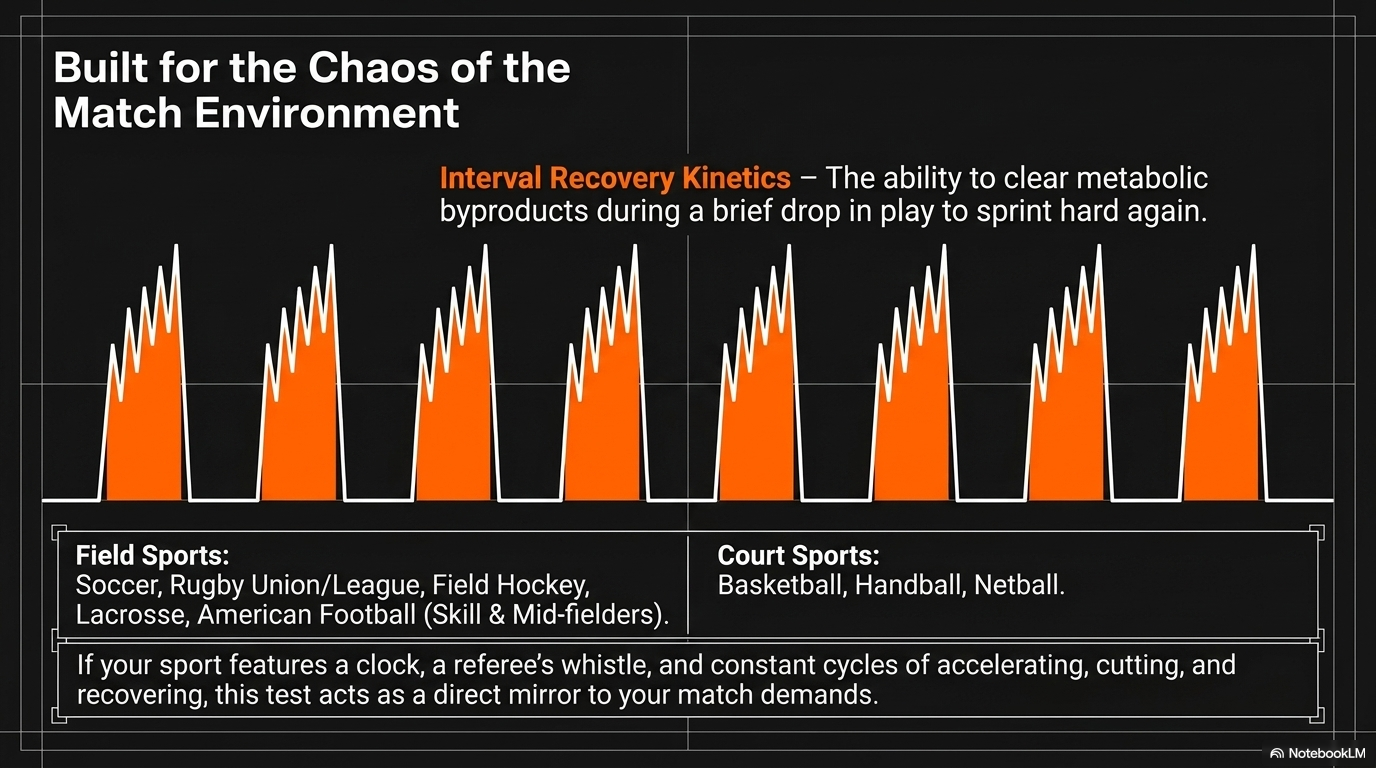
If your sport features a clock, a referee's whistle, and athletes constantly accelerating, cutting, and recovering, the 30-15IFT is your definitive assessment. The protocol was specifically engineered to mirror the intermittent nature of field and court play.
It is the absolute gold standard for:
In these environments, performance hinges on interval recovery kinetics—the physiological ability to clear metabolic byproducts during a brief drop in play (passive rest) to facilitate another maximum effort sprint.
"The 30-15IFT was practically built in a lab for sports featuring a clock, a referee's whistle, and athletes constantly accelerating, cutting, and recovering."
Precision Scaling: From Youth Prospects to Million-Dollar Pros
A common misconception is that high-level intermittent testing is reserved for professional organizations with massive sports science budgets. In reality, the 30-15IFT is one of the most scalable tools in a consultant's arsenal.
The "Skip It" List: When the Test Becomes a Mistake
Forcing an athlete through a 30-15IFT when their sport doesn't demand the specific blend of metrics that create VIFT is a waste of metabolic capital.

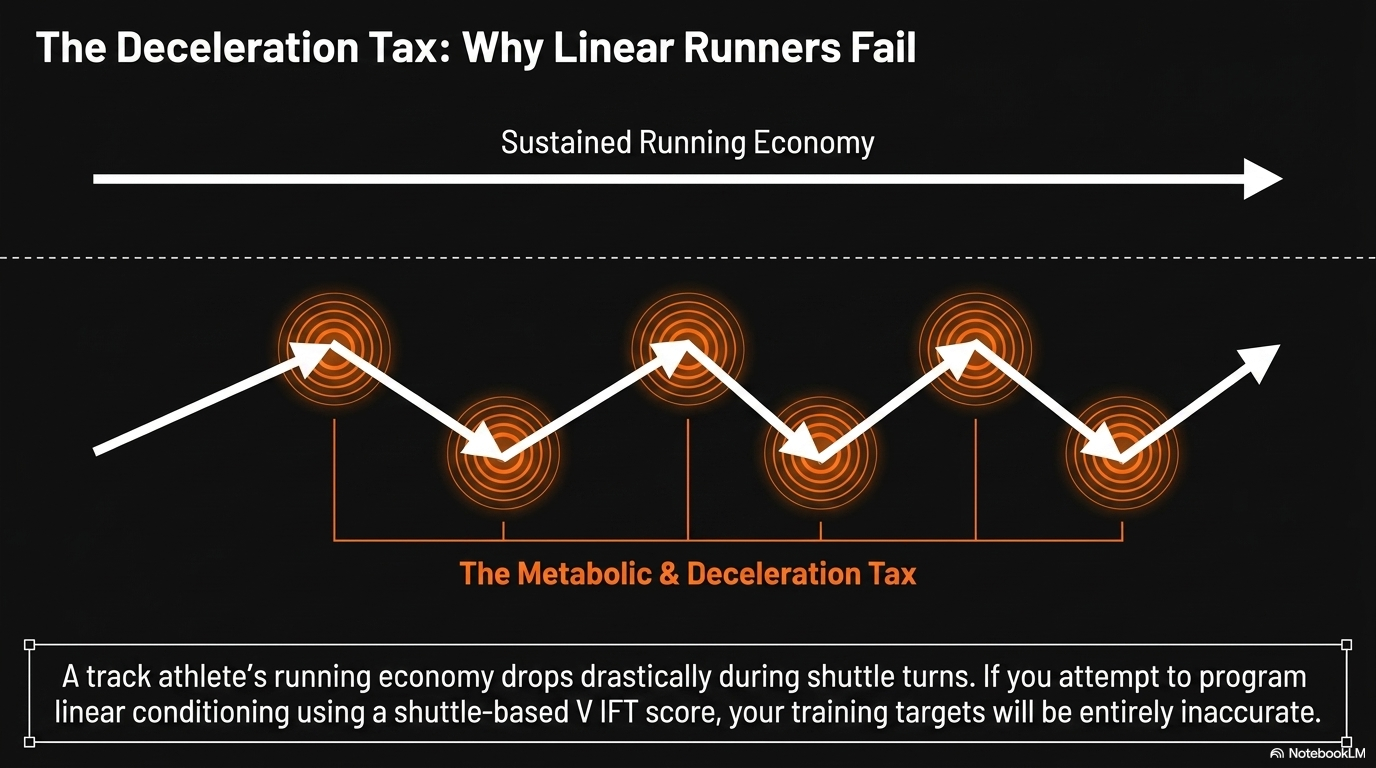
PRO TIP: The Running Economy Trap Do not use a shuttle-based VIFT score to program linear conditioning for track athletes. A linear runner’s economy drops significantly during shuttle turns due to the energy cost of deceleration. Using these results for straight-line intervals will result in training targets that are far too slow to elicit a stimulus.
Takeaway 4: It’s a Mirror, Not Just a Timer
The 30-15IFT is more than a cardiovascular assessment; it is a compound metric. VIFT is a mathematical composite of aerobic power, anaerobic capacity, and Change-of-Direction (COD) efficiency.
Traditional continuous tests fail team sport athletes because they ignore the massive metabolic cost of decelerating and re-accelerating. By incorporating these turns under increasing fatigue, the 30-15IFT acts as a mirror to the match environment. It captures the athlete’s ability to maintain high-intensity output throughout a full match, making it a superior predictor of field-based fitness compared to any test that only measures straight-line running.
The Pre-Flight Checklist: Safety and Readiness
Because the 30-15IFT demands aggressive deceleration and 180-degree turns while the athlete is in a state of high fatigue, it carries a distinct mechanical load. Before you blow the whistle, you must audit your athletes' physical readiness:

Beyond the Number
A tool is only as effective as its application. Obtaining a VIFT score is merely the diagnostic phase; the next step is the "prescription"—translating that speed into highly precise, individualized interval workouts. This eliminates the guesswork of "group-think" conditioning and ensures every athlete is working at their specific threshold.
As you look at your upcoming training block, ask yourself: Does your current testing protocol actually reflect the chaos of game day, or are you just measuring how well your athletes run in a straight line? If it's the latter, it's time to upgrade your toolbox.
References