
August 24, 2026

The 24-Hour Illusion: Why Your Athletes Aren’t as Recovered as They Look
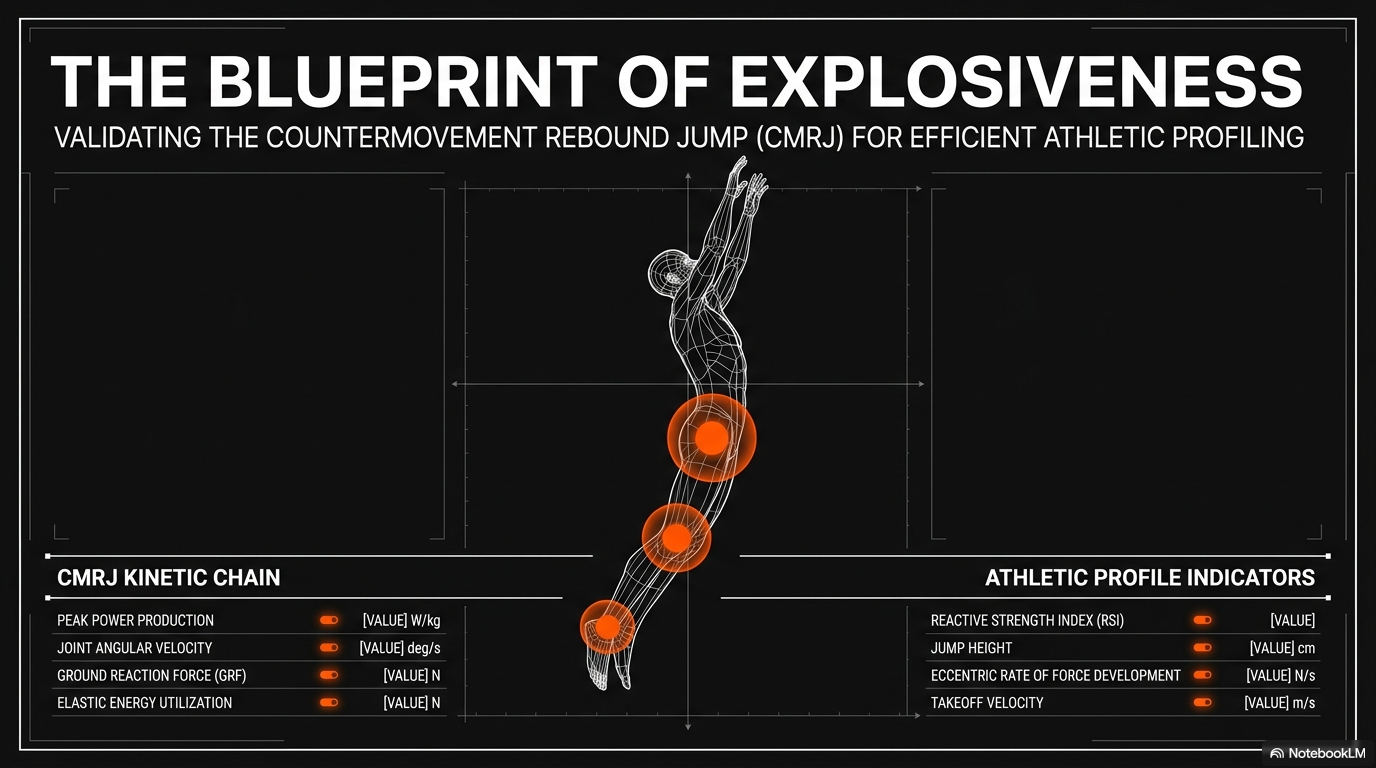
"Acute Effects of Repeated Sprints on Performance Measures During the Countermovement Rebound Jump" is a 2025 study co-authored by Jiaqing Xu, Anthony Turner, Matthew J. Jordan, Thomas M. Comyns, Shyam Chavda, and Chris Bishop. This research examines how acute, sprint-induced fatigue impacts performance outcomes and execution strategies in elite team-sport athletes over a 24-hour recovery period. The researchers conducted this study to examine how a realistic fatiguing stimulus—specifically, a controlled repeated-sprint protocol with a 180° change of direction—affects these jump metrics and their recovery over a 24-hour period, validating whether the CMRJ can serve as a practical, noninvasive monitoring tool in athletic field settings."
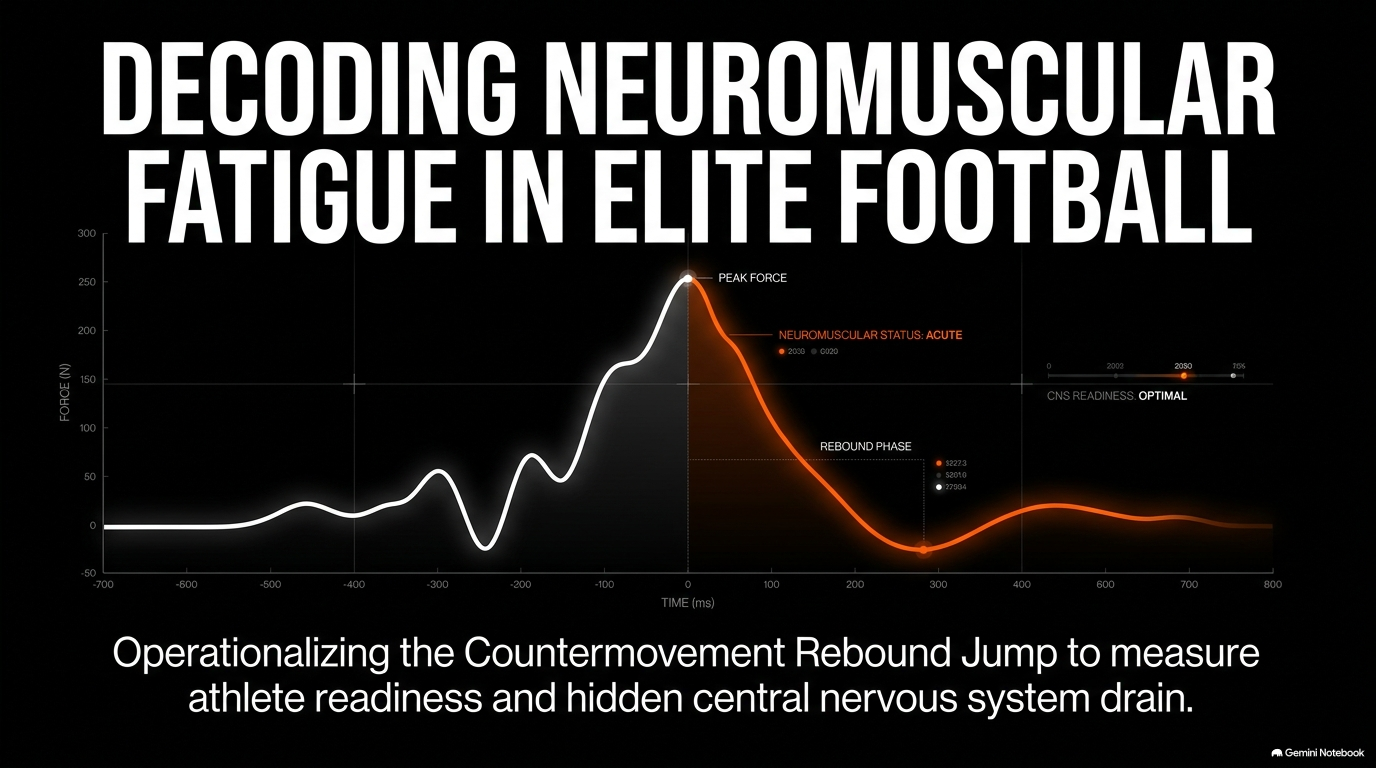
The nervous system is an expert at masking its own deficiencies. In high-performance environments, the most dangerous athlete is the one who appears "fresh"—hitting target jump heights and maintaining their usual training rhythm—while operating on a depleted neural battery. This is the practitioner’s dilemma: an athlete manipulates their movement strategy to achieve a familiar outcome, only for their performance to crater mid-session or, worse, result in a soft-tissue injury.
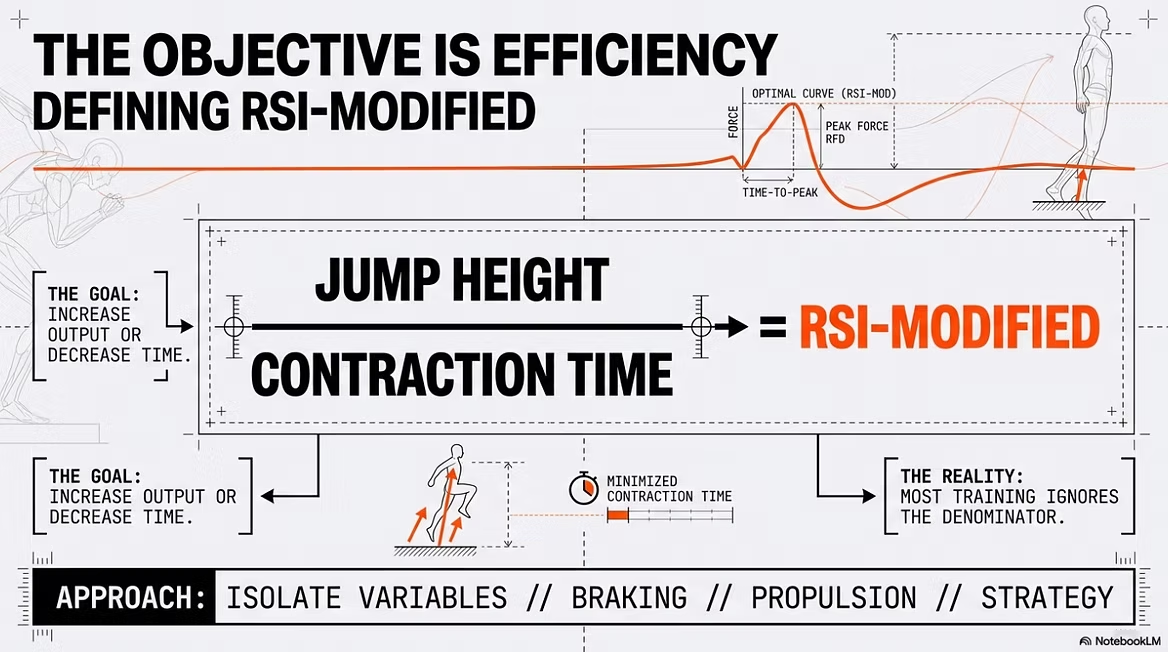
To see past this façade, we must move beyond simple height metrics. The Countermovement Rebound Jump (CMRJ) serves as a diagnostic playbook for the nervous system by assessing both "slow" and "fast" stretch-shortening cycle (SSC) mechanics across the critical 250-ms threshold. Recent data from Xu et al. (2025) reveals that the "strategy" an athlete uses to jump is often more telling than the jump itself.
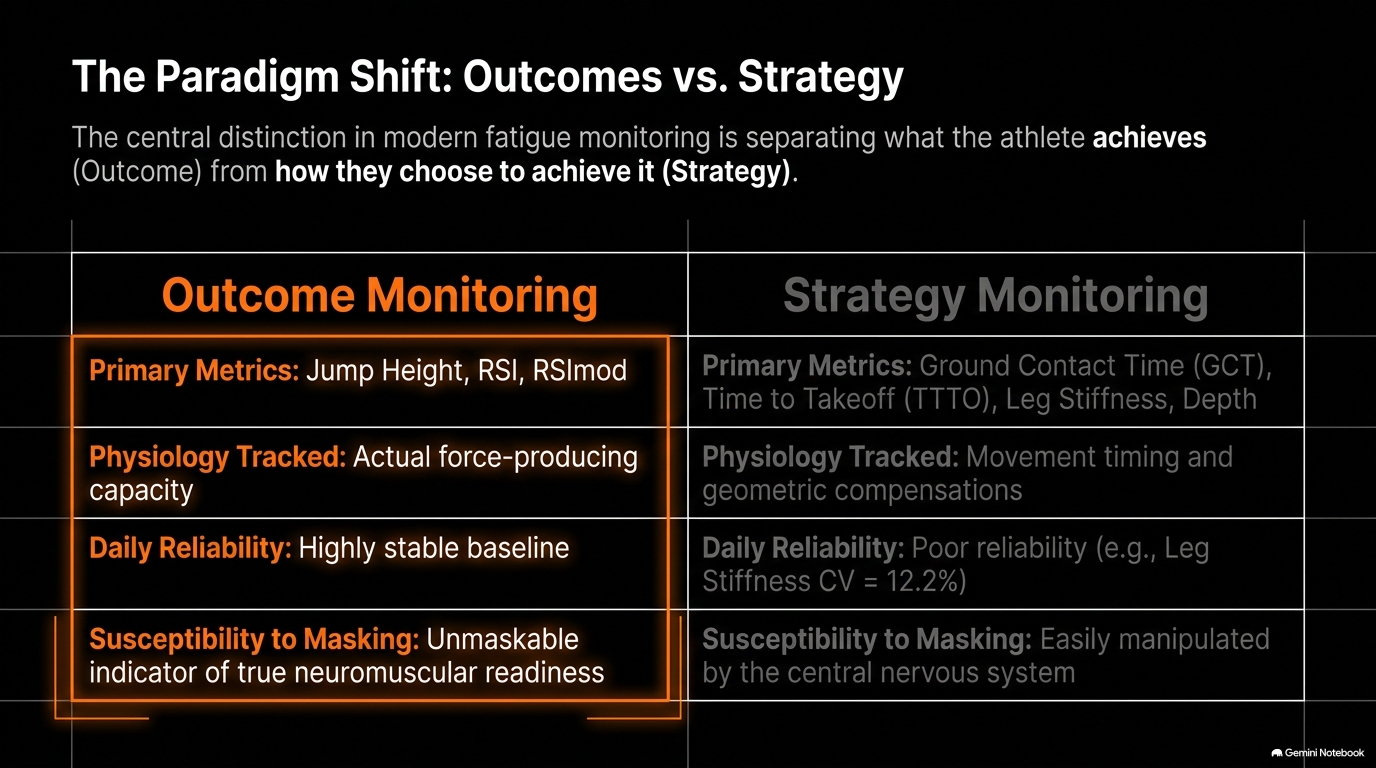
Takeaway 1: Track Outcomes, Not the Strategy
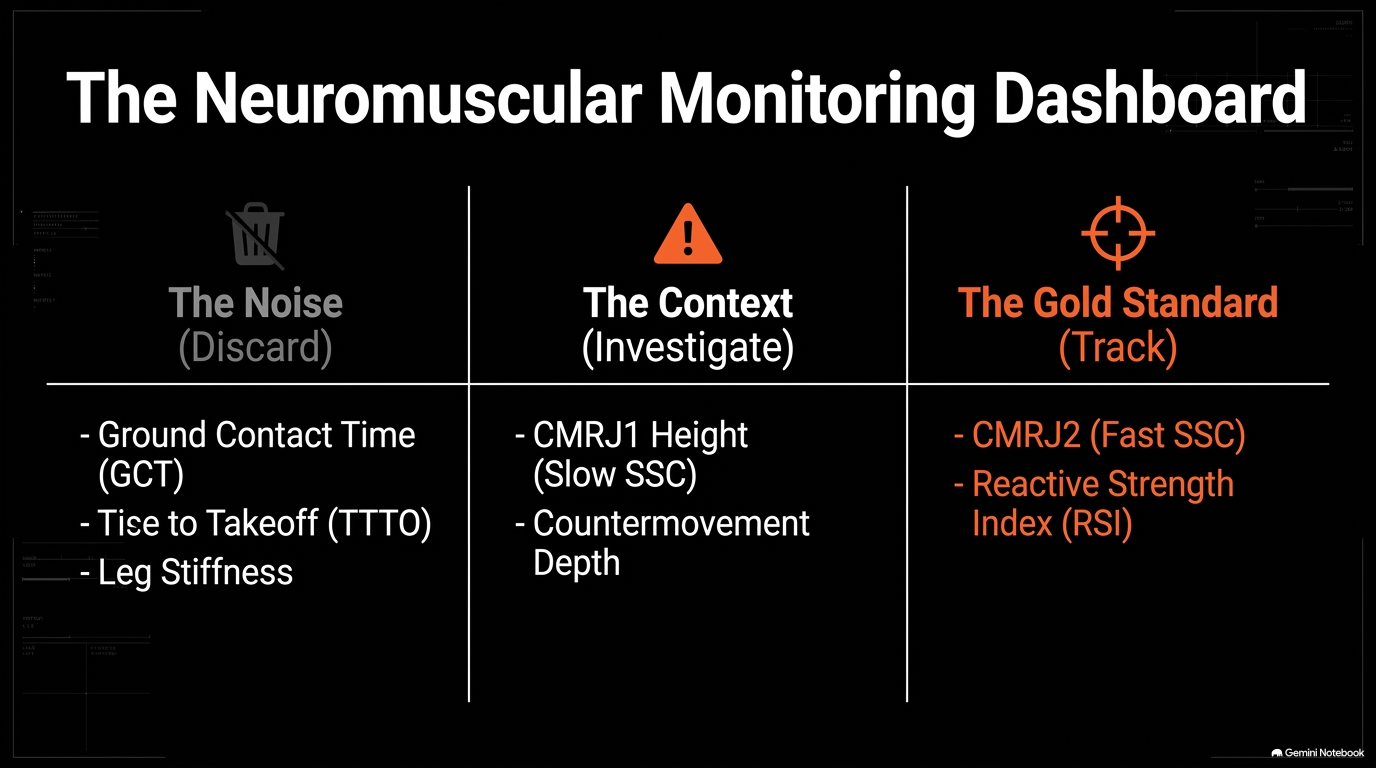
The central nervous system is remarkably resilient in preserving "timing." When fatigued, athletes often maintain their Ground Contact Time (GCT) and Time to Takeoff (TTTO), preserving the rhythm of the movement even when they can no longer produce the required force magnitude. In this context, rhythm is a liar. Because the motor program’s timing remains stable while the impulse-generating capacity craters, practitioners who only watch the clock will miss the onset of fatigue.
"Jump height and RSI are your gold standard for acute fatigue. Do not rely on Ground Contact Time or Time to Takeoff to tell you if an athlete is tired today."
Takeaway 2: The Myth of Leg Stiffness in Acute Monitoring
Leg stiffness is a common KPI, but as a marker for daily readiness, it is essentially noise. The Xu et al. data demonstrates that leg stiffness exhibits poor reliability for acute monitoring, evidenced by a 12.2% Coefficient of Variation (CV).
Athletes are master compensators. When fatigued, they instinctively alter their body geometry—shifting joint angles at the ankle, knee, and hip—to protect tired tissues and mitigate eccentric load. These mechanical shifts make leg stiffness a distracting metric that fails to reflect true neuromuscular status.
Practitioners should discard leg stiffness as a primary marker for daily readiness checks in favor of more stable outcome measures.
Takeaway 3: The "Depth Trap"—How Athletes Mask Fatigue
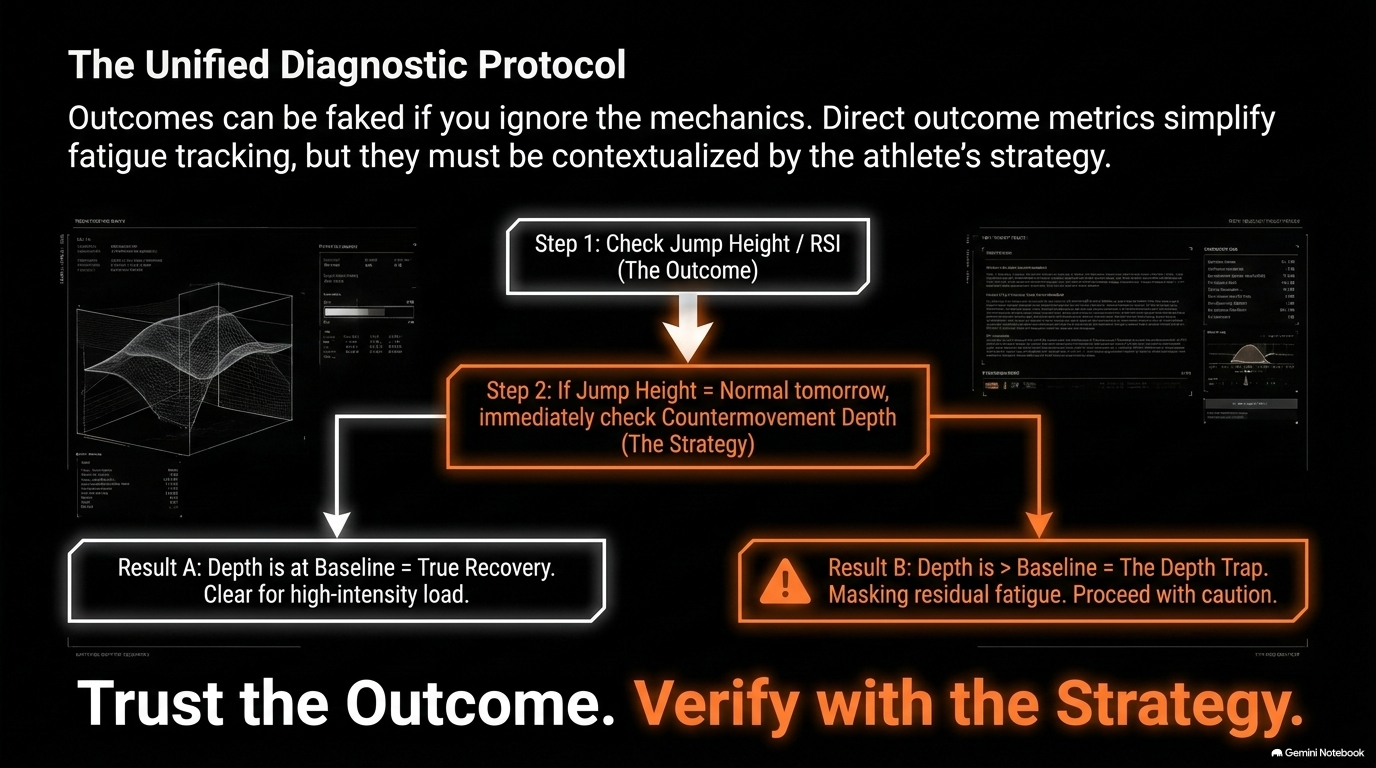
The most deceptive phase of recovery occurs at the 24-hour mark. This is the "Depth Trap." At this point, CMRJ1 (Slow SSC) height may return to baseline, suggesting the athlete is recovered. However, a closer look at the strategy reveals they are hitting that height by significantly increasing their countermovement depth.
This is a mechanical compensation: by squatting deeper, the athlete is "buying time" to generate net propulsive impulse over a longer distance. They are using a slower, more deliberate strategy to mask a reduced ability to produce force rapidly. If you aren't monitoring depth, you are clearing fatigued athletes for high-intensity loads.
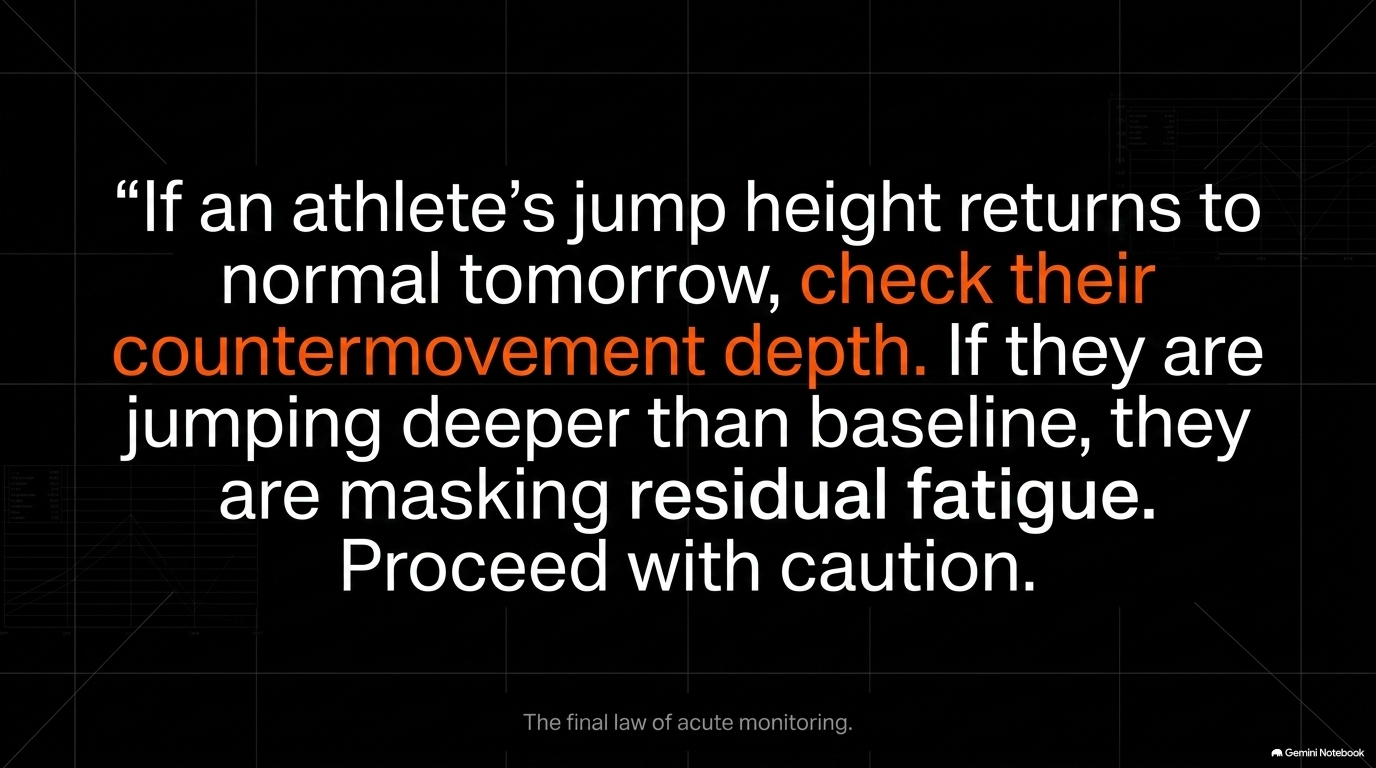
"If an athlete’s jump height returns to normal tomorrow, check their countermovement depth. If they are jumping deeper than baseline, they are masking residual fatigue. Proceed with caution before clearing for high-intensity loads."
Takeaway 4: The Recovery Timeline is Non-Linear
Recovery is a bimodal process, not a straight line. The transition from metabolic stress to neural and structural recovery creates a specific fatigue time course that practitioners must recognize.
Fatigue Time Course Reference:
Conclusion: Moving Beyond the Surface
The CMRJ is not just a test of vertical power; it is a window into the athlete’s neuromuscular survival strategies. By monitoring the relationship between jump height and countermovement depth, you can see through the 24-hour illusion and identify the moment an athlete stops being "ready" and starts being "lucky."
If your athlete hits their target today by changing their strategy, are they actually ready for a high-intensity load, or are they just one jump away from an injury?
Article Reference
Xu, J., Turner, A., Jordan, M. J., Comyns, T. M., Chavda, S., & Bishop, C. (2025). Acute effects of repeated sprints on performance measures during the countermovement rebound jump. Journal of Strength and Conditioning Research, 39(7), e834–e842