

June 22, 2026
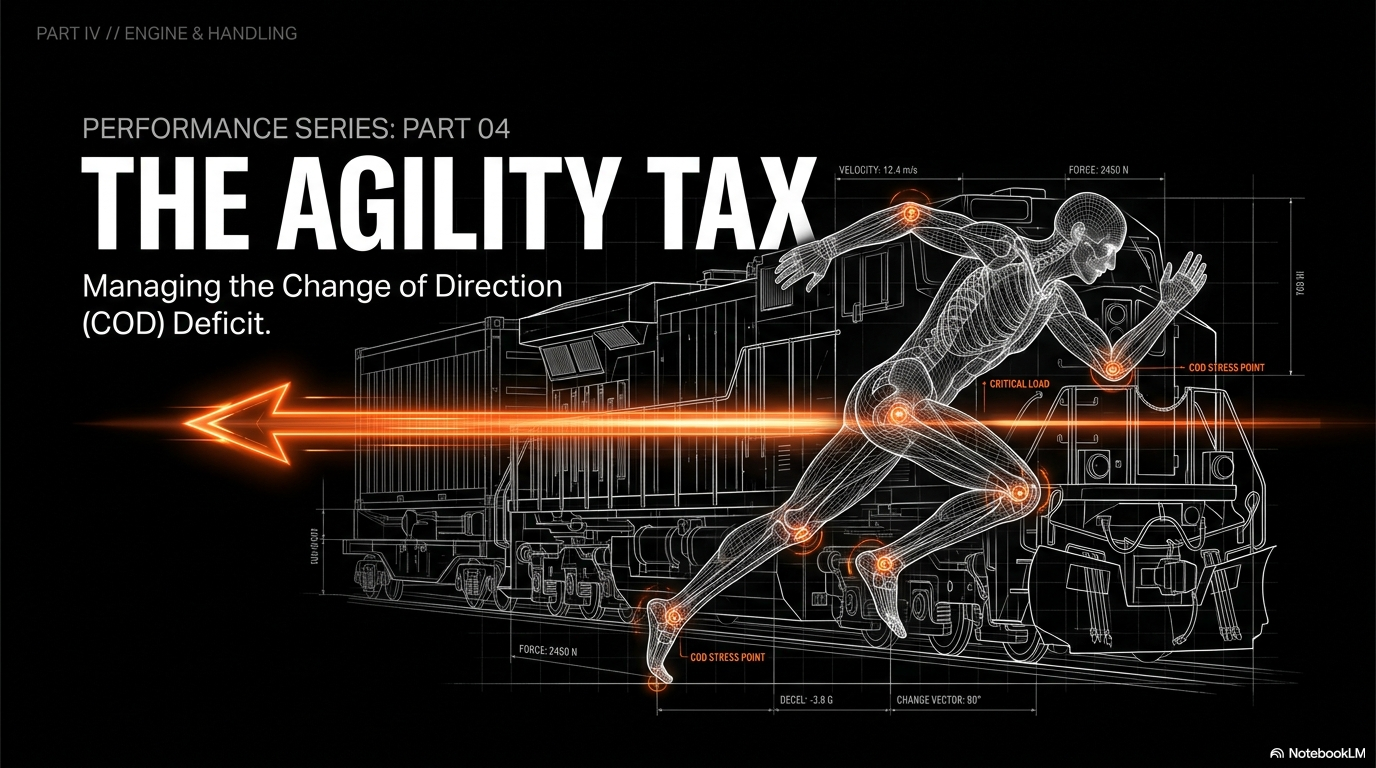
The Agility Tax — Managing the Change of Direction Deficit
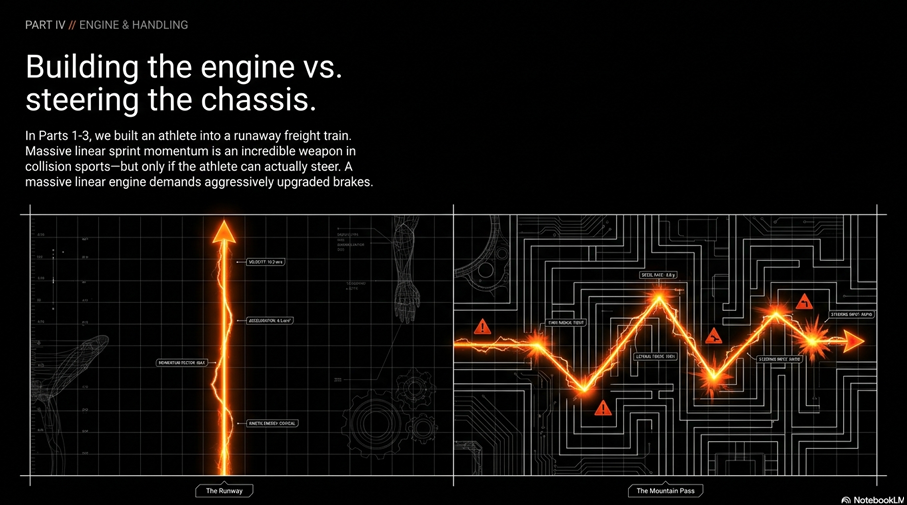
The Hook: The Freight Train Dilemma It is one thing to build an athlete into a runaway freight train in a straight line, but it is a completely different challenge to navigate that train through a winding mountain pass. In field and collision sports, linear speed and massive sprint momentum are incredible weapons, but only if the athlete can actually steer their own chassis.
Far too often, performance programs build straight-line powerhouses only to watch them get humiliated on game day by agile playmakers cutting back against their grain. Raw momentum must always be balanced against transfer efficiency and handling.
Paying the Agility Tax
If you build a massive linear engine, you must aggressively upgrade your brakes. If an athlete's body weight scales upward but their ability to stop, plant, and re-accelerate plummets, they have paid a massive, counter-productive "Agility Tax". To survive the modern game, an athlete must efficiently transfer linear momentum into lateral agility; otherwise, they are just a liability waiting to get exposed.
Deconstructing the COD Deficit
Historically, coaches evaluated agility by timing standard tests like the Pro Agility (5-10-5) or the L-Run. The problem is that a player with an elite linear velocity ceiling will often clock a fast overall agility time just because they are incredibly fast in the straight-line portions. This completely masks their mechanical inefficiency during the actual turn.

Modern high-performance systems solve this by tracking the Change of Direction (COD) Deficit, which isolates the turn from the sprint using the 5-0-5 Schematic:
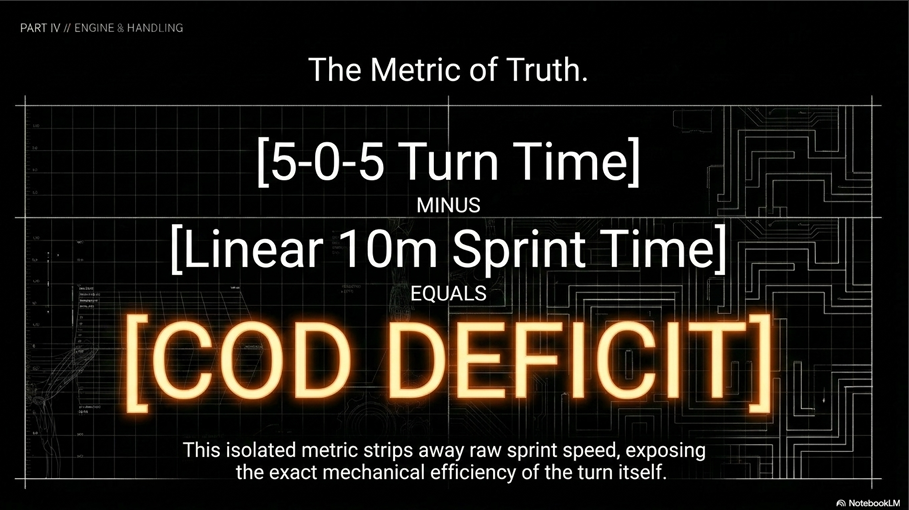
A lower COD deficit proves high transfer efficiency, showing the athlete can drop their center of mass, absorb forces, and re-accelerate with minimal lost speed. Conversely, a high deficit is a massive red flag indicating dangerous kinetic energy leaks.
The Physics of High Momentum & Injury Risks Why does the COD Deficit skyrocket when an athlete gets heavier?
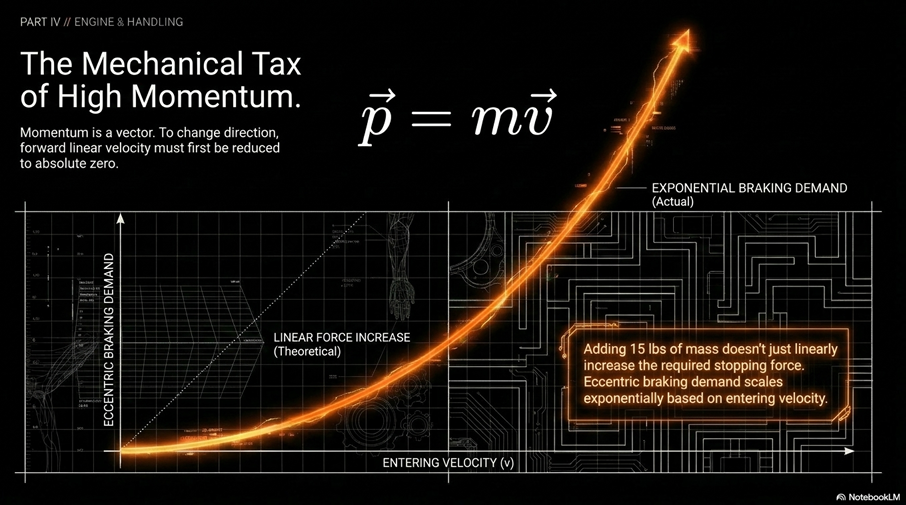
It comes down to basic physics: Momentum is a vector quantity
When an athlete with high sprint momentum wants to change direction, they must first apply a massive eccentric braking force into the ground to bring their forward linear velocity to zero. As shown in the data, adding 15 lbs of mass doesn't just linearly increase the required stopping force; the eccentric braking demand scales exponentially based on entering velocity.
If an athlete boasts high momentum but lacks eccentric strength, two major physical regressions occur:
The Coach's Takeaway
Research utilizing the 5-0-5 protocol proves that linear sprint speed and change of direction efficiency are completely independent physical qualities. An athlete can be in the 95th percentile for straight-line velocity but the bottom 30th percentile for COD efficiency. Fast does not mean agile.
To fix this, elite programs upgrade the brakes through specific applied protocols: Eccentric Strength Overload (handling exponential braking forces), Targeted Deceleration Mechanics (isolating the penultimate step), and Lateral Force Transfer.
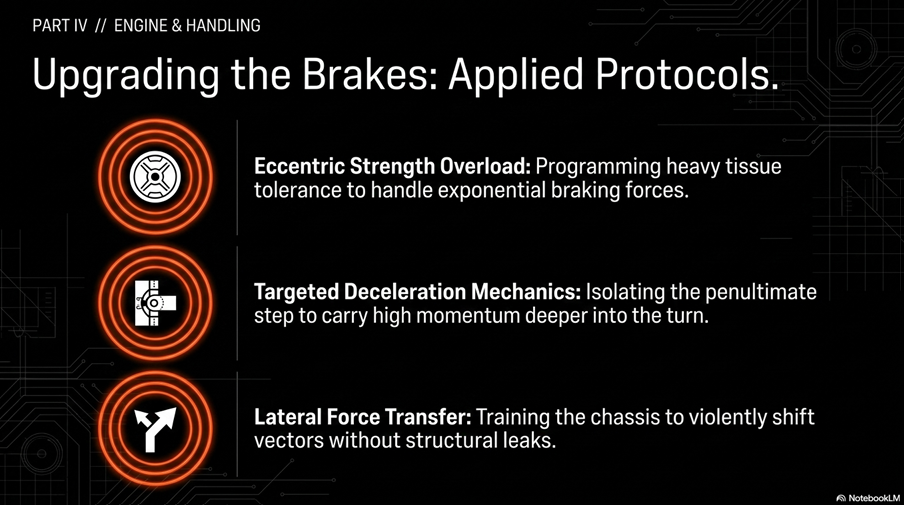
Final Directive: Use the COD Deficit as your metric of truth. If linear momentum climbs but the deficit widens, stop chasing mass. Shift your training volume to eccentric deceleration loading and change-of-direction mechanics. Mass is only a weapon if you can control it under chaos.

References