

November 2, 2026
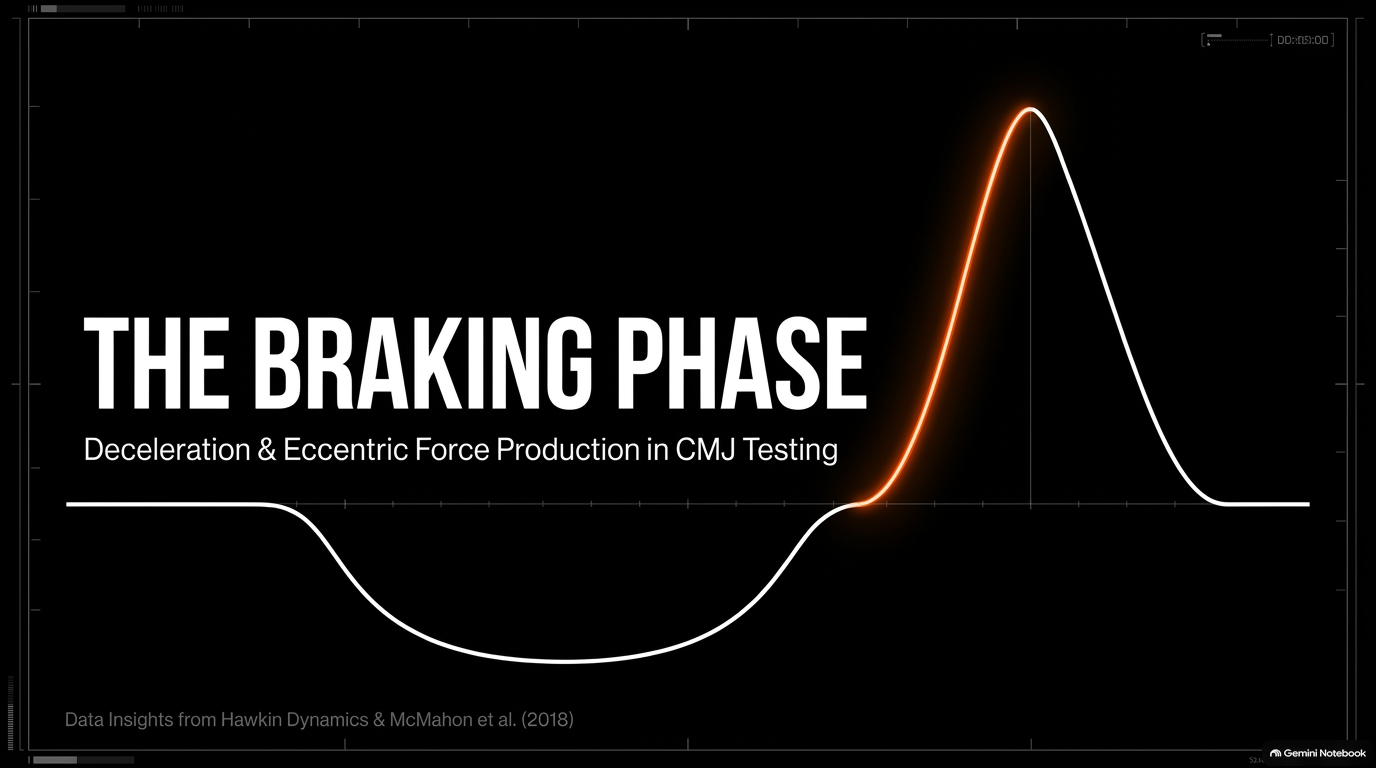
While jump height and explosive takeoff dominate traditional performance testing, an athlete’s jump height is fundamentally constrained by how effectively they decelerate their mass during the downward descent. Phase 3 of the Countermovement Jump (CMJ)—the Braking Phase—quantifies an athlete’s eccentric deceleration qualities and force production capacity. Initiated the millisecond vertical ground reaction force rises back above baseline System Weight and ending when downward center-of-mass velocity reaches zero, the braking phase stores elastic strain energy and sets the structural foundation for subsequent propulsive power. By evaluating braking net impulse, peak braking force, and eccentric rate of force development (RFD), performance practitioners can identify kinetic bottlenecks, tailor eccentric strength programming, and optimize reactive performance across different athletic populations.
Following the unweighting phase—where an athlete drops into their countermovement and force dips below baseline—the body must actively halt its downward momentum before it can drive upward. This transition initiates the Braking Phase (frequently referred to as the eccentric deceleration phase).
Mechanically, the braking phase begins when ground reaction force returns to equal the athlete’s System Weight (measured during the initial quiet phase) following the minimum force trough. During this crucial window:
Rather than viewing the countermovement jump as a single explosion, force plate technology breaks the movement down into a continuous kinetic chain:
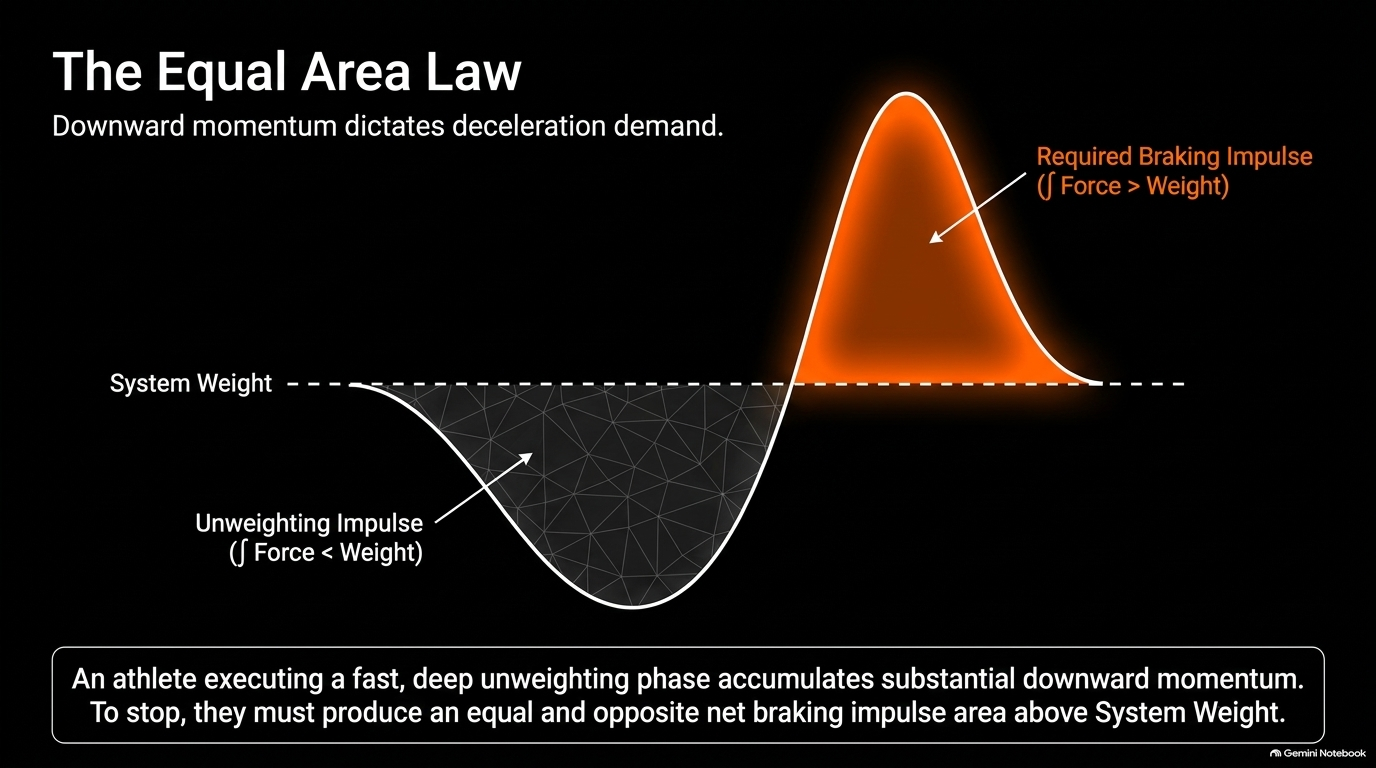
In force plate biomechanics, impulse is defined as the integral of net force over time:

By subtracting System Weight from total ground reaction force, this equation isolates the net force driving changes in the athlete's center-of-mass velocity. According to Newton’s Impulse-Momentum Theorem, the negative Unweighting Net Impulse accumulated during the downward acceleration dip directly dictates the required Braking Net Impulse needed to bring downward velocity back to exactly 0 m/s.
If an athlete executes a fast, deep countermovement drop, they generate substantial downward momentum. To stop this momentum at the bottom of the movement ("in the hole"), the athlete must produce an equal and opposite net braking impulse area above System Weight. If their eccentric muscle strength or structural stiffness is inadequate, the athlete will be forced to either:
The exact boundary where the braking phase ends and the propulsive phase begins is known as the Transfer Point or switch phase. At this instant, vertical velocity hits exactly 0 m/s at maximum downward displacement.
Performance coaches frequently conceptualize this transition as the amortization period (similar to the vertex of Cal Dietz’s "Triphasic V"). Athletes who minimize time spent at 0 m/s transfer eccentric strain energy into concentric propulsion far more efficiently, resulting in higher reactive strength index (RSI) values and greater explosive power output.
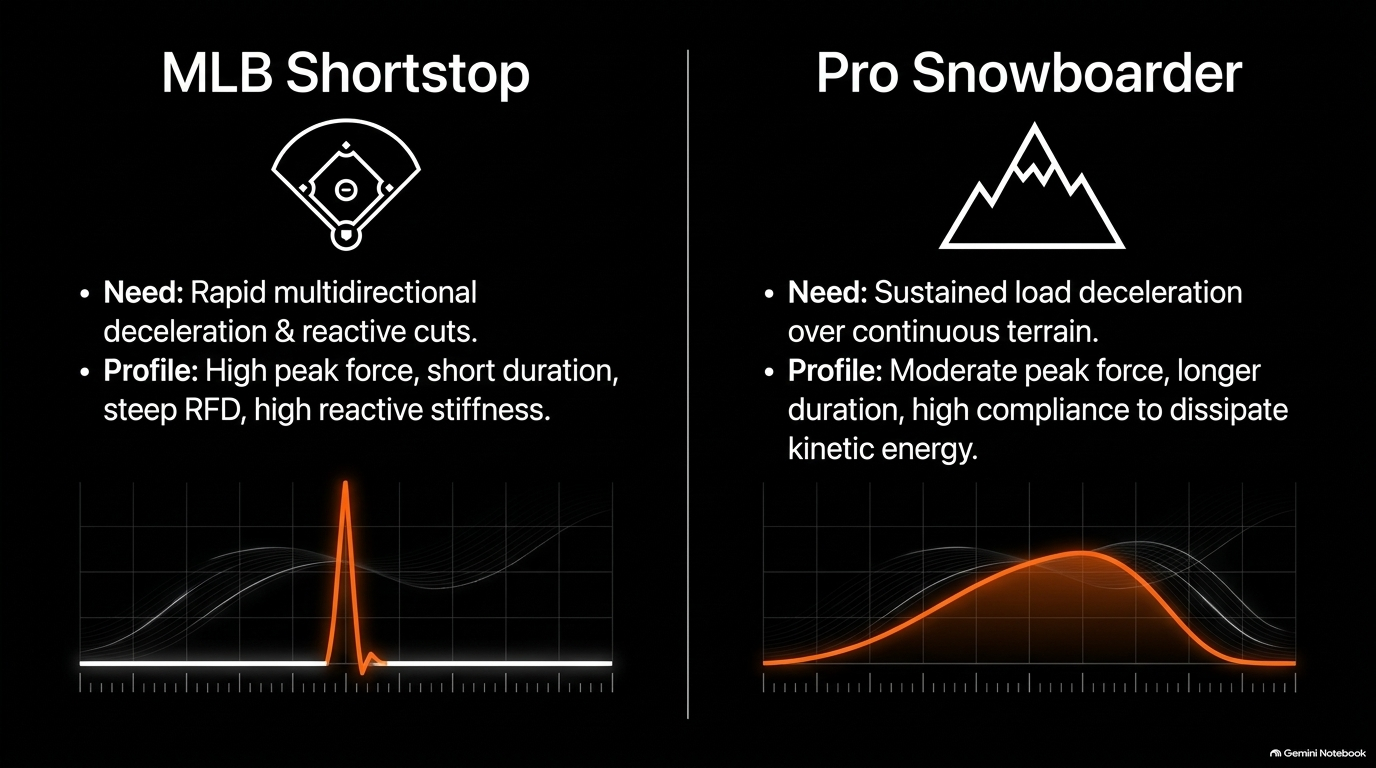
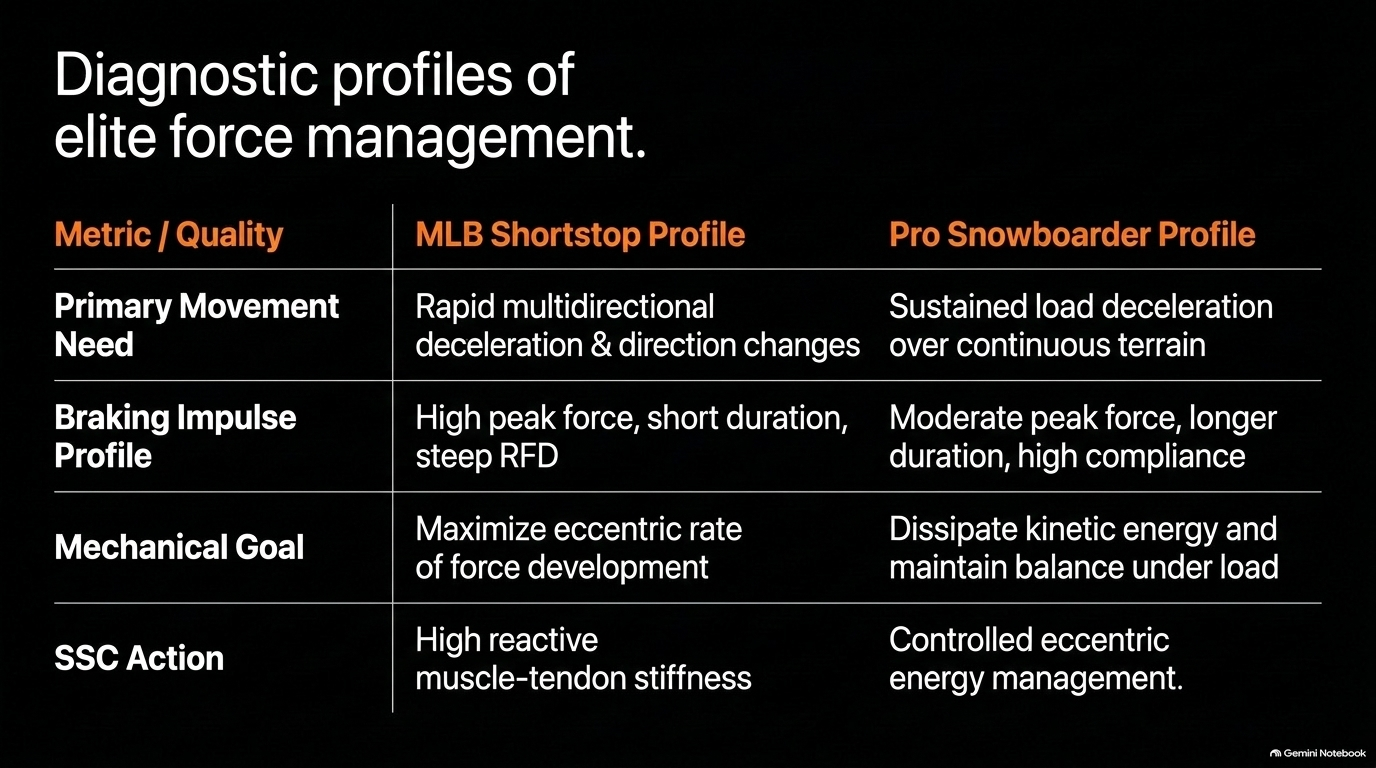
Not all athletes utilize or require identical braking mechanics. As highlighted in the Hawkin Dynamics CMJ Playbook, comparing different athletic populations reveals distinct biomechanical strategies based on sport constraints:
An MLB shortstop requires steep eccentric rate of force development to halt high momentum rapidly during fielding and base-running cuts. Conversely, a snowboarder must manage sustained, high-magnitude loading across varied snow topography, yielding an extended deceleration profile.
When force plate diagnostics reveal a deficit in peak braking force or an excessively long braking duration, strength and conditioning coaches should implement targeted training interventions:
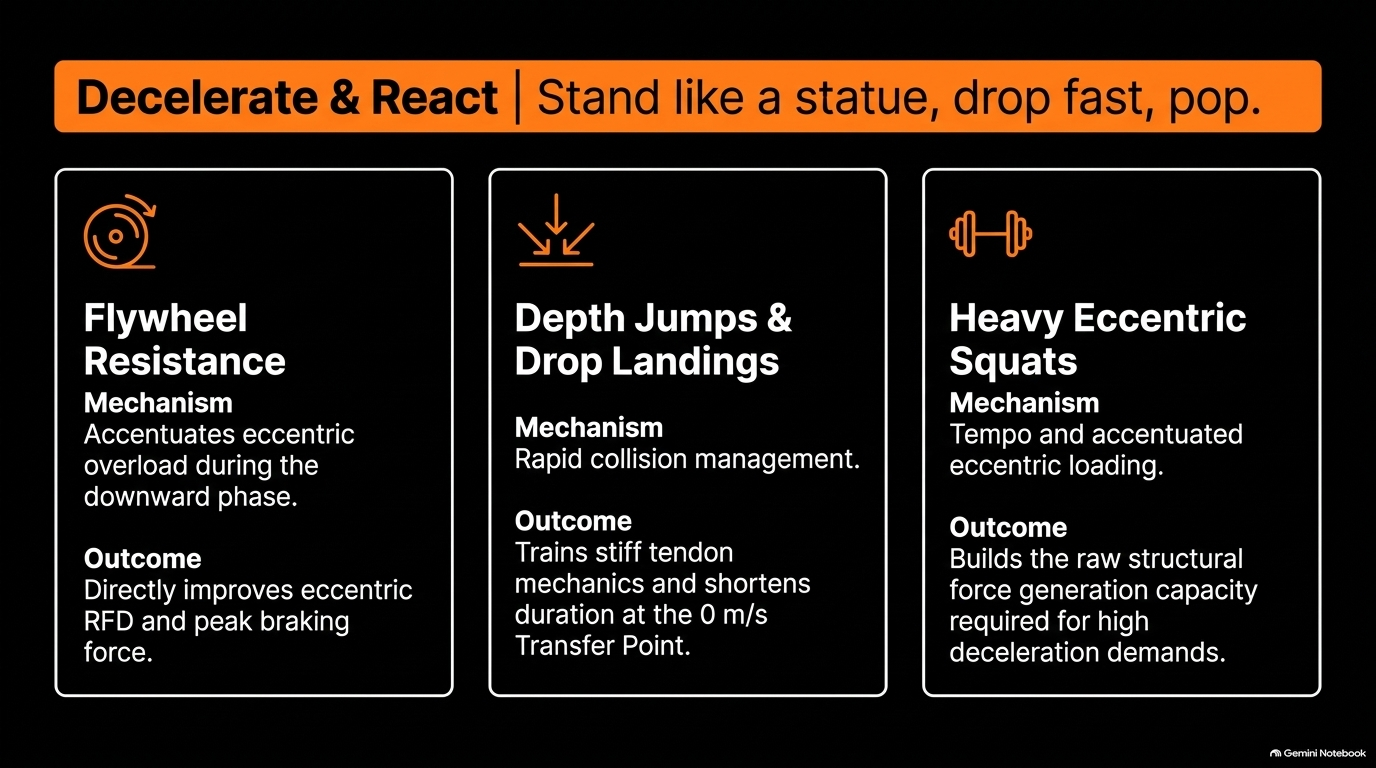
As documented in the Hawkin Dynamics Performance Team research (Understanding Countermovement Jump Force-Time Curves: The Countermovement Jump Playbook), analyzing phase-specific mechanics provides coaches with clear diagnostic insights that jump height alone cannot reveal. Additional foundational research by McMahon et al. (2018) in the Strength & Conditioning Journal confirms that quantifying net braking impulse and peak braking force is essential for evaluating athletic deceleration and stretch-shortening cycle function.
Content adapted and credited to the Hawkin Dynamics CMJ Playbook.