
July 20, 2026
In Part 2, we established that if you coach field or court sports, the 30-15 Intermittent Fitness Test (30-15IFT) is your ultimate diagnostic tool. But a fitness test is only as valuable as the training it informs.
If you take your athletes’ test scores, file them away in a spreadsheet, and go right back to making your squad run generic, un-timed baseline laps, you are completely wasting your time.
The crown jewel of this entire protocol is a single number: vIFT (the final velocity reached during the test). Today, we are going to look at why traditional programming metrics break down in team sports, and how you can use vIFT to build highly precise, individualized high-intensity interval training (HIIT) that hits the exact same physiological target for every single player on your roster.
To understand why vIFT is a programming cheat code, we first have to look at how most modern conditioning is prescribed: Maximal Aerobic Speed (MAS).
Typically, a coach runs a linear time trial (like a 1.5-mile run or a 5-minute continuous track test), divides the distance by time, and finds the athlete’s top steady-state aerobic speed. They then write an interval workout based on percentages of that score—for example, running 15-second shuttles at 120% of their MAS.
On paper, it looks scientific. In practice, it causes absolute chaos across a team.
Because traditional MAS only measures linear, continuous aerobic engine size, it completely ignores an athlete’s change of direction (COD) abilities and their anaerobic toolkit.
If you put an explosive, naturally anaerobic winger and a slow-twitch, high-endurance central midfielder on the exact same line-drill based on their traditional MAS scores:
You have given one player a lethal dose of fatigue and completely undertrained the other.

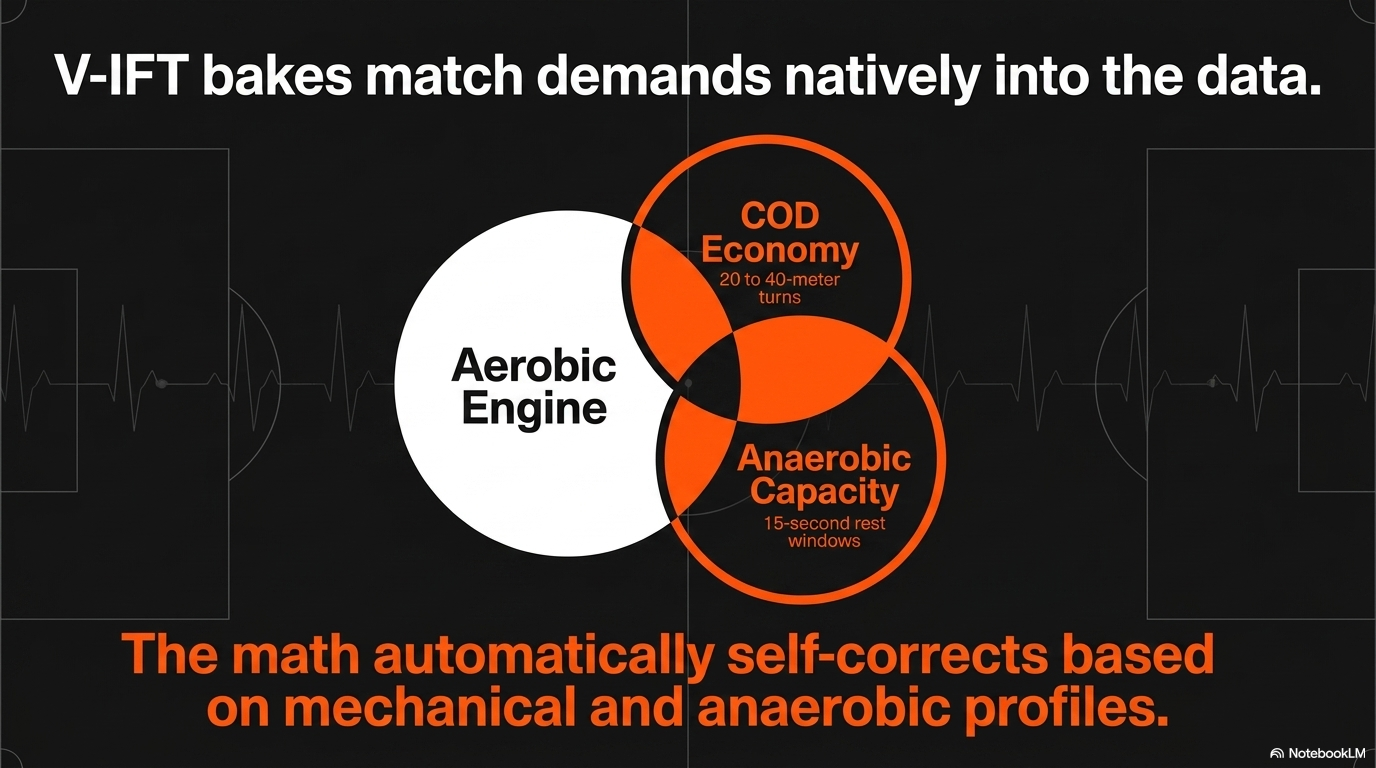
Because the 30-15IFT forces athletes to turn around every 20 or 40 meters and includes a brief 15-second rest window, the final score (vIFT) natively bakes in their anaerobic capacity and their change-of-direction economy.
When you prescribe high-intensity intervals using a percentage of vIFT, the math automatically self-corrects:
By using vIFT to individualize your drills, a 20-player squad running side-by-side will experience the exact same relative physiological stress, regardless of their vastly different physical profiles.
When designing high-intensity interval training, sports scientists target specific intensities of vIFT depending on the type of HIIT workout. For classic short-interval conditioning (e.g., 15 seconds of work, 15 seconds of rest), coaches typically target 95% to 105% of vIFT.
Here is how you turn a test score into an exact, localized running distance for next week’s practice:
Take the athlete's final vIFT score (measured in km/h) and divide it by 3.6.
Example: Midfielder A finishes the test at stage 18 (18.0 km/h).

Multiply their m/s score by your workout's target percentage. Let’s say we want a demanding 100% $V_{\text{IFT}}$ session.

Multiply that adjusted speed by the number of seconds they will be running per rep. Let's build a classic 15-second interval block.

The Prescription: During next week's conditioning block, every time the whistle blows, Midfielder A has exactly 15 seconds to cover 75 meters, followed by 15 seconds of rest. A slower player on the team might only have to cover 64 meters in that same 15 seconds, while your elite athlete might be chasing 82 meters.
Everyone finishes at the exact same moment. Everyone gets the exact same training effect.


We have covered the history, identified the target athletes, and unlocked the programming math. All that is left is flawless execution. In our final installment, Part 4: Step-by-Step Implementation and Common Pitfalls to Avoid, we will give you the exact tactical blueprint for test day—from cone setup and audio management to the subtle pacing cheats you must watch out for to keep your data pure.