
July 27, 2026

We’ve covered the scientific origins, identified who the test is for, and unlocked the programming math behind vIFT. Now comes the most important part: flawless execution on test day.
A field test is only as good as its standardization. If your cones are set up two meters short, or if your athletes cheat their turns, your vIFT calculations will be completely compromised—meaning your upcoming training blocks will be built on broken data.
In this final installment of our series, we are going to walk through the exact logistical blueprint for setting up the 30-15IFT, managing test day, and identifying the common execution mistakes that ruin data quality.

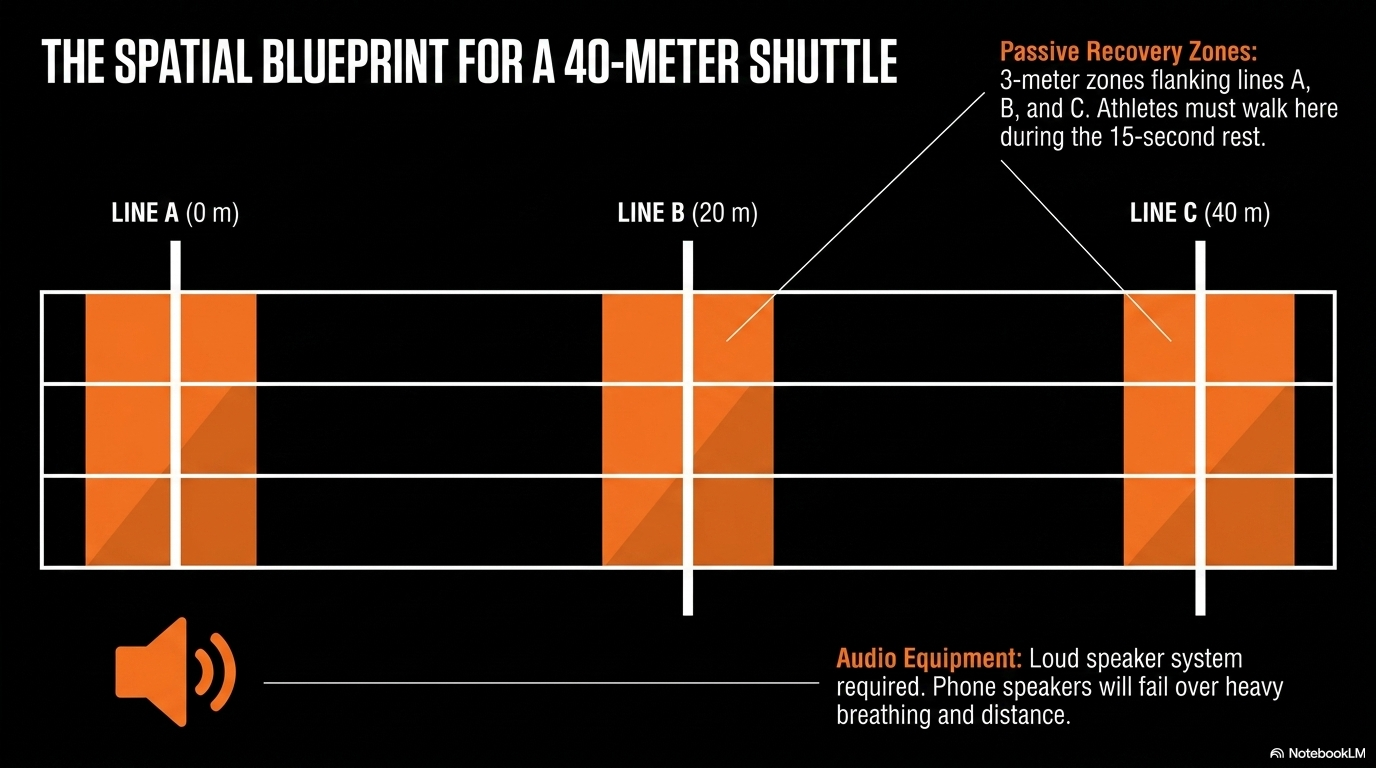
Setting up the 30-15IFT correctly requires precision. Unlike simple 20-meter shuttle tests, the standard 30-15IFT uses a 40-meter shuttle layout divided into specific zones.
Spatial Blueprint:
1.Briefing & Pacing Walkthrough: 10 minutes before. Gather your athletes and explain the pacing rules. Emphasize that early stages are for calibration, not sprinting. Clarify that they must hit the lines on or before the beep—not after.
2.Standardized Warm-Up: 10–15 minutes before. Perform a dynamic warm-up that includes multi-directional mobility, sub-maximal accelerations, and a few practice shuttle turns at light speeds.
3.Group Staggering: Lineup. Assign 4 to 8 athletes per lane/zone depending on field width. Ensure they have enough room to turn without colliding with teammates.
4.Execution & Monitoring: During test. Have assistants stand along the 0m, 20m, and 40m lines to monitor line compliance and record when an athlete fails to reach the zone twice consecutively.

When fatigue sets in, athletes naturally look for shortcuts. Keep a close eye on these three classic failure points:
In the first 3 to 4 stages, eager athletes often sprint ahead of the beeps and wait at the turning line. This wastes valuable anaerobic energy early on. The rule: Athletes must match their speed to the audio pacing signals from start to finish.
To save distance, fatigued athletes will often turn 1 to 2 meters before reaching the marked line.
During the 15-second rest window, athletes must remain in or walk slowly within the nearest 3-meter zone. If an athlete jogs down to the next line during rest to gain an advantage for the next 30-second stage, their recovery score becomes invalid.

An athlete's test officially terminates under two conditions:
Important: The score recorded is the velocity vIFT of the last successfully completed stage, not the stage where they failed.

Over this 4-part series, we've taken the 30-15IFT from a complex sports science paper and turned it into an actionable coaching framework:
Now, it's time to download the audio track, set up your cones, and take the guesswork out of your team's conditioning block!