
June 29, 2026

If you missed any pieces of our deep dive, you can catch up here:
Today, we are zooming out to look at the entire landscape. By combining all four pillars of the Locomotor Profile, we can build a diagnostic framework that turns raw athletic potential into a precise, calculated weapon.
The Master Framework: Engine vs. Handling Dynamics
As visualized in the master telemetry dashboard, an athlete cannot be evaluated by a single, isolated metric. True game-day performance is dictated by how their Engine Dynamics (energy production and raw speed) interface with their Handling Dynamics (force multiplication and structural maneuverability).
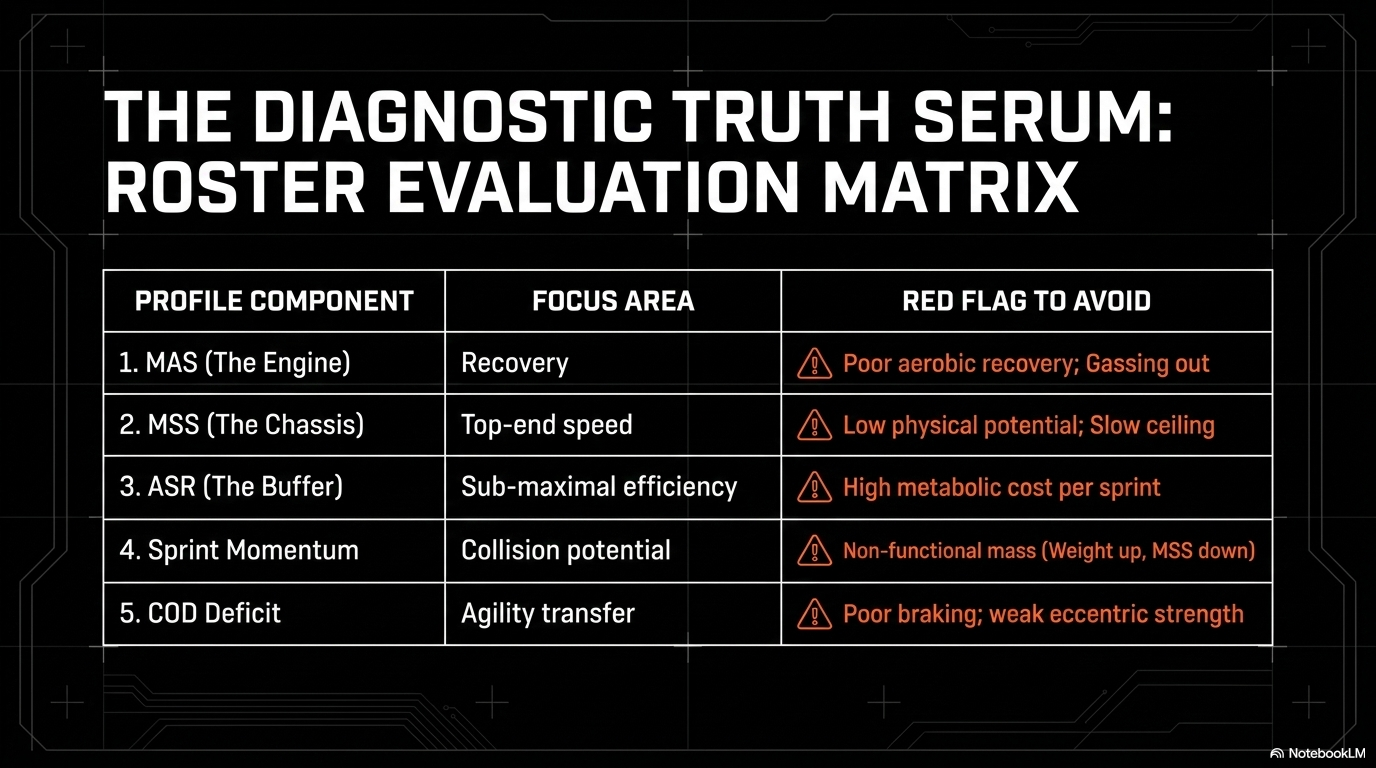
Your journey begins by mapping the absolute floor and ceiling of your locomotive machine. Maximal Aerobic Speed (MAS) dictates your engine's capacity to flush metabolic waste and recover between high-intensity plays. Maximal Sprint Speed (MSS) dictates your neuromuscular ceiling—the top-end absolute velocity of your chassis.
The physiological gap between your floor and your ceiling forms your Anaerobic Speed Reserve (ASR). As we uncovered in Part 2, blindly chasing a higher number on the scale during "bulking season" often introduces Non-Functional Mass. If an athlete becomes heavier and slower, their MSS ceiling collapses, their ASR buffer shrinks, and they are thrown into the Red Zone of Anaerobic Distress—gassing out prematurely because they are forcing a weak engine to push an unathletic chassis.
Once an athlete's raw velocity ceiling plateaus in their early twenties, their window for career-long dominance shifts. As proven by Baker & Newton (2008), elite senior athletes separate themselves from junior prospects by scaling their Sprint Momentum ($\text{Body Mass} \times \text{Velocity}$). By strategically utilizing functional hypertrophy and heavy resisted sled training, mature veterans can safely scale the size of their machine, carrying devastating kinetic energy directly to the point of contact.
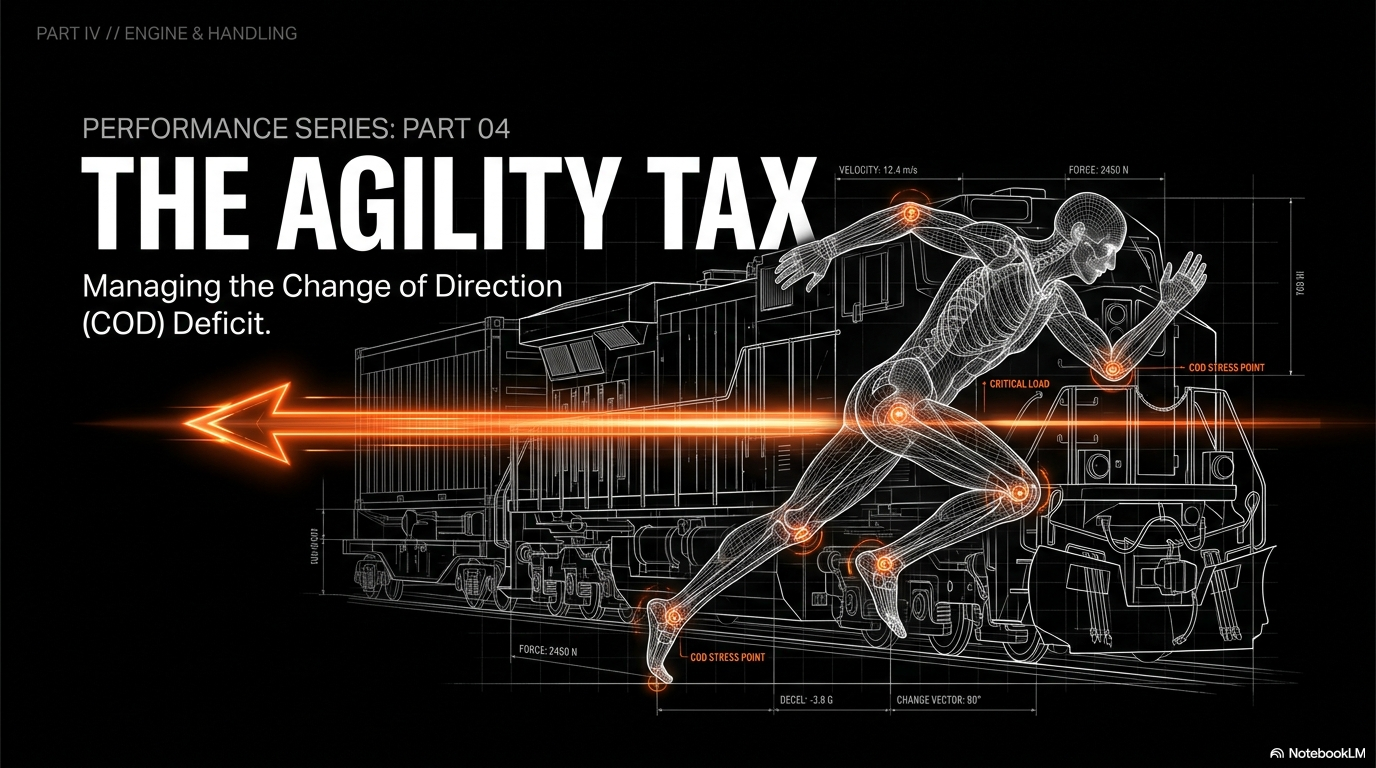
But building a runaway freight train is entirely counter-productive if you can't steer it. As we established in Part 4, massive linear sprint momentum demands elite eccentric braking strength. To ensure your athletes can efficiently transfer linear power into lateral agility without leaking energy or blowing out an ACL, coaches must stringently monitor the Change of Direction (COD) Deficit utilizing the 5-0-5 Schematic.
Look at the matrix below and run your roster through this quick diagnostic truth serum:
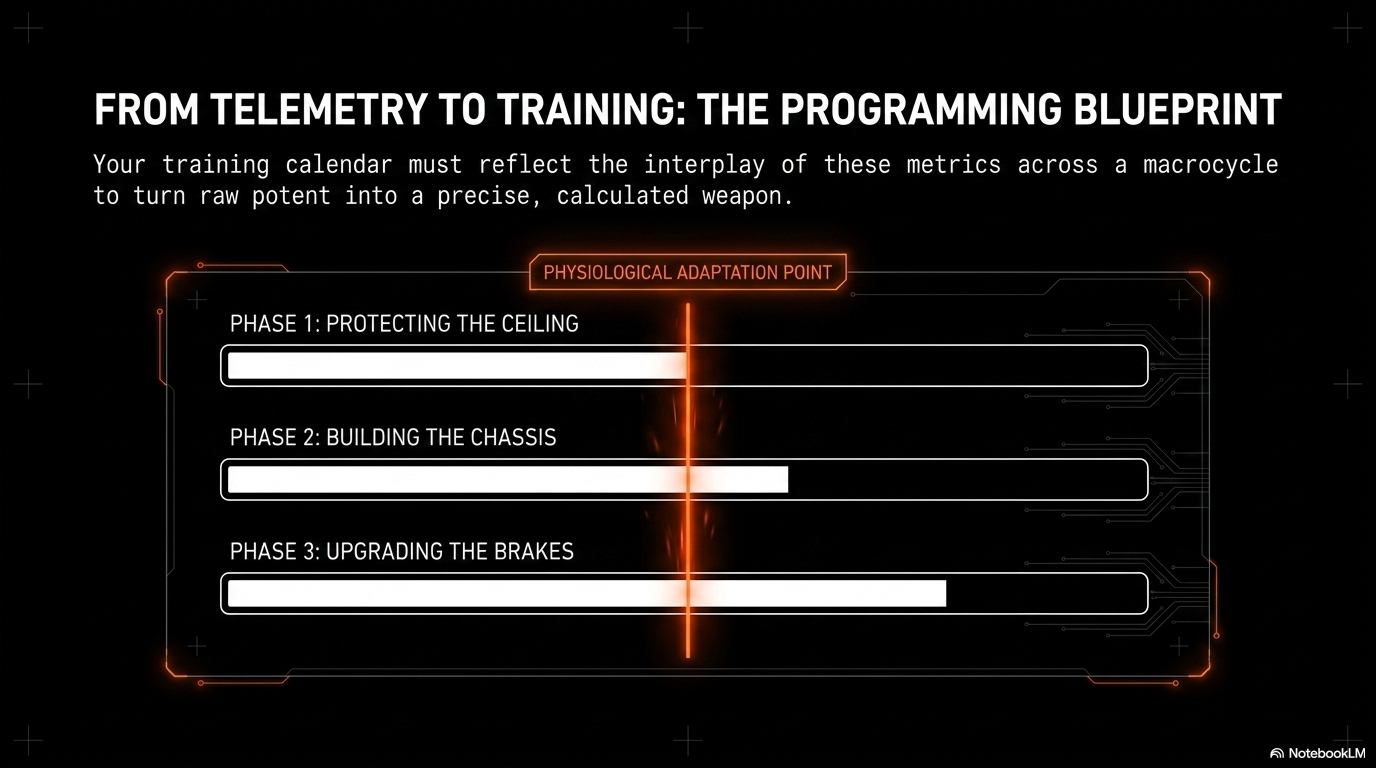
To turn this four-part series into an actionable strategy, your training calendar must reflect the interplay of these metrics. Here is how you program for a complete Locomotor Profile across a macrocycle:
You cannot manage what you do not measure.
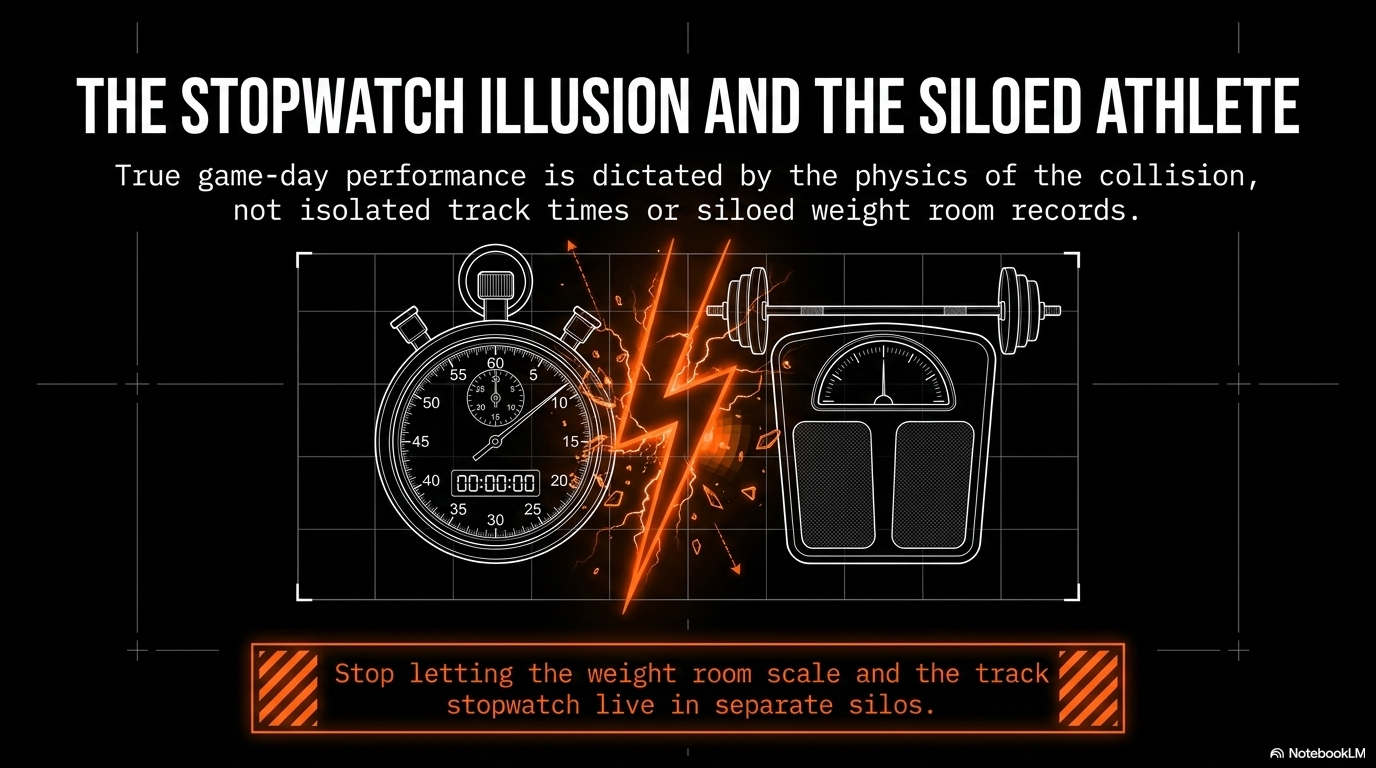
Stop letting the weight room scale and the track stopwatch live in separate silos. If you want to develop athletes who survive the brutal collisions of modern field sports while remaining agile, explosive, and conditioned, you must manage the entire profile.
Build a massive engine (MAS), elevate the speed ceiling early (MSS), strategically expand the mass of the machine over a career to maximize collision potential (Sprint Momentum), and relentlessly upgrade the brakes to maintain elite handling (COD Deficit). Optimize the whole athlete, dominate the grass, and leave spreadsheets to the accountants.