THE PROPULSIVE PHASE: UNDERSTANDING PROPULSIVE IMPULSE AND CONCENTRIC FORCE PRODUCTION IN COUNTERMOVEMENT JUMP TESTING
Whistle Peformance
November 9, 2026
THE PROPULSIVE PHASE: UNDERSTANDING PROPULSIVE IMPULSE AND CONCENTRIC FORCE PRODUCTION IN COUNTERMOVEMENT JUMP TESTING
Understanding the countermovement jump (CMJ) force-time curve requires looking far beyond jump height. While jump height remains the single most frequently cited outcome metric across sports performance testing, it represents merely the final product of an interconnected kinetic chain. As established in the foundational research framework by Dr. John McMahon, Dr. Jason Lake, Dr. Timothy Suchomel, and Dr. Paul Comfort, alongside the Hawkin Dynamics Performance Team, every phase of the jump—from the motionless baseline of the quiet phase through unweighting and braking—builds the kinetic momentum that culminates in concentric push-off.
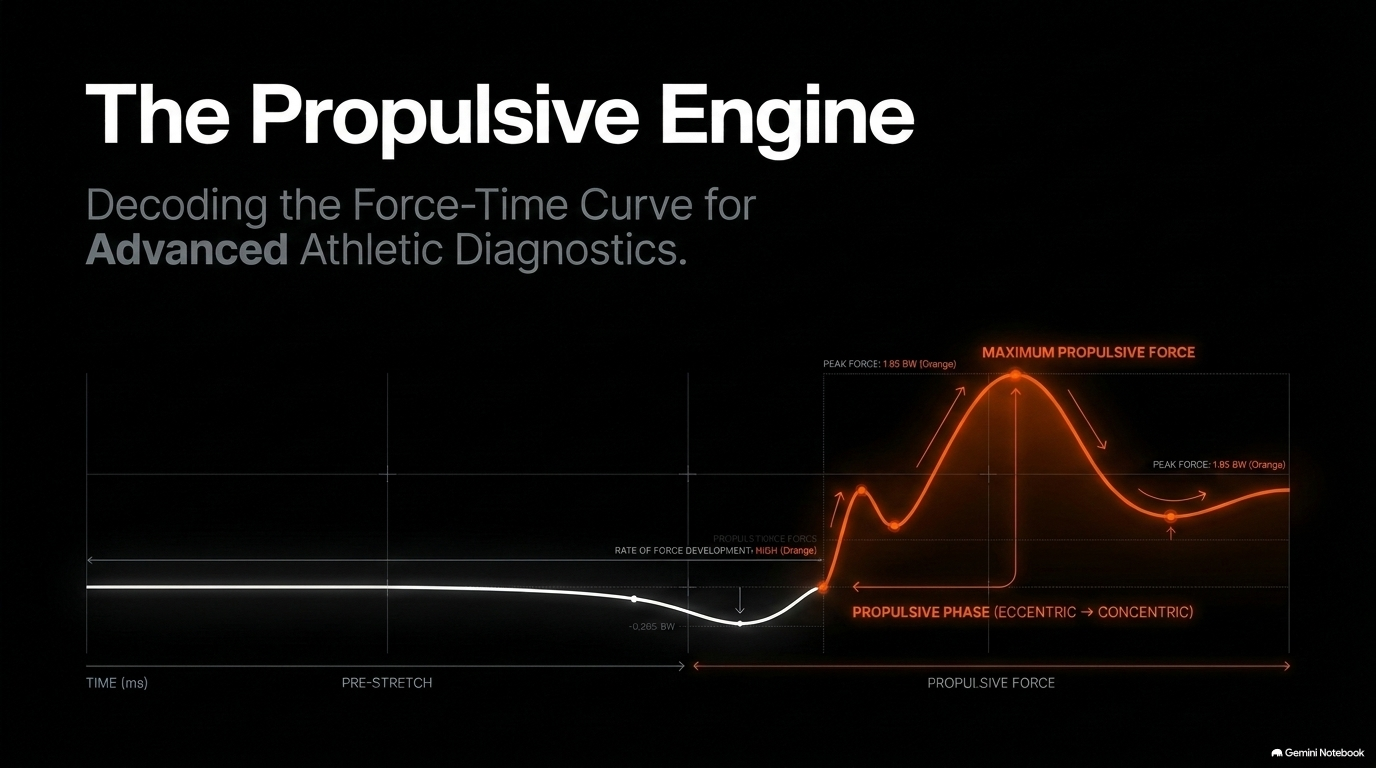
Phase 4, known as the Propulsive Phase (or concentric propulsion phase), serves as the mechanical engine of the jump. It is during this phase that the athlete actively converts stored elastic energy and neuromuscular force into positive vertical velocity, driving the center of mass (COM) upward until takeoff.
1. Biomechanical Boundaries and Phase Identification
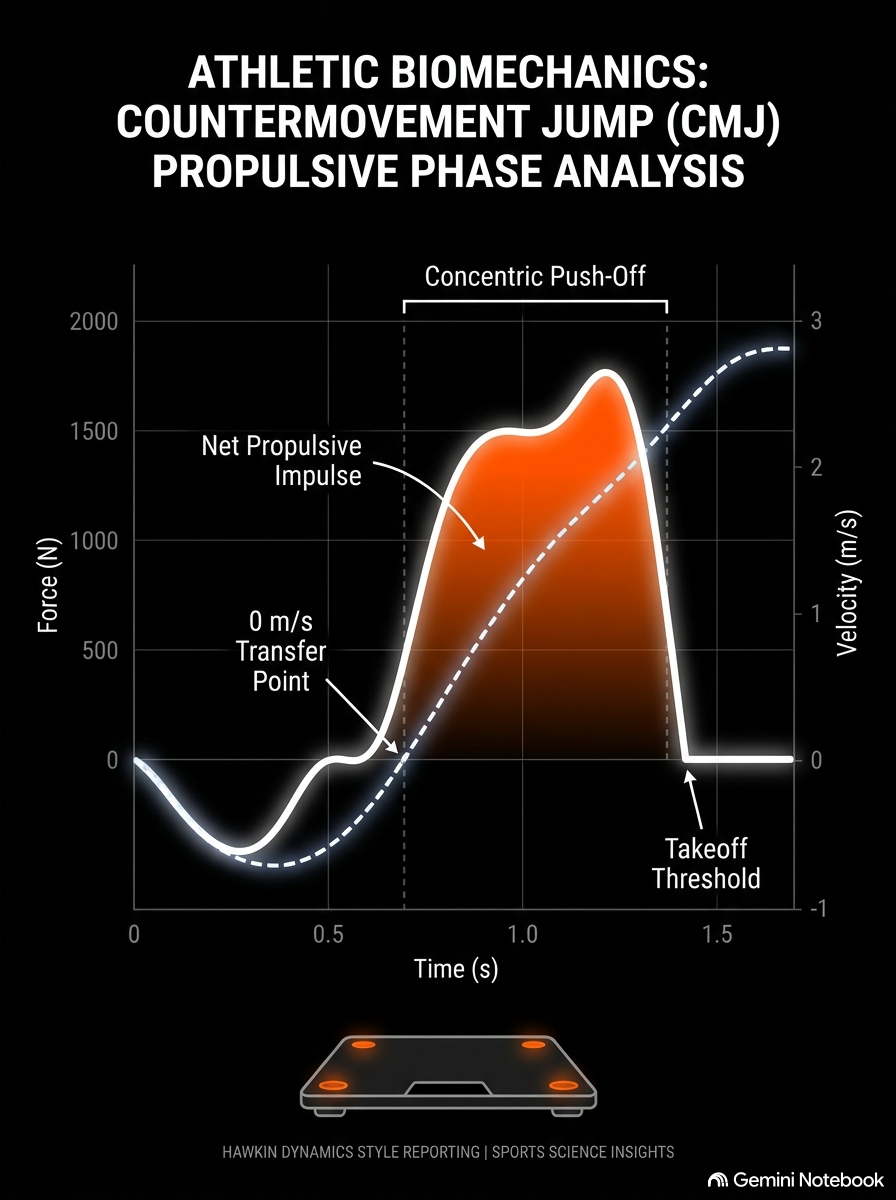
In force-time curve analysis, precise phase delineation is essential for data integrity. The propulsive phase begins the exact instant that positive vertical COM velocity is achieved following the bottom of the countermovement dip.
In automated force plate software such as Hawkin Dynamics, this onset is operationally identified when COM upward velocity crosses a positive threshold value of 0.01 m/s. Visually and kinematically, this transfer point coincides with the inflection point where COM downward displacement reaches its lowest point ("in the hole") and transitions into an ascending trajectory.
The propulsive phase terminates at takeoff, defined as the instant vertical ground reaction force falls below a designated threshold (typically set at a fraction of system weight or zero force threshold), signifying that the athlete has detached from the force plates and entered the flight phase.
During propulsion, the athlete undergoes powerful triple extension—simultaneous concentric extension of the hips, knees, and ankles. The magnitude and duration of force generated during triple extension dictate how rapidly momentum is imparted to the athlete's body mass.
2. Kinetic Physics and Impulse Mechanics
The primary determinant of jump height is takeoff velocity, which is governed strictly by the impulse-momentum relationship. Net impulse represents the area under the force-time curve above system weight over a specified time duration.
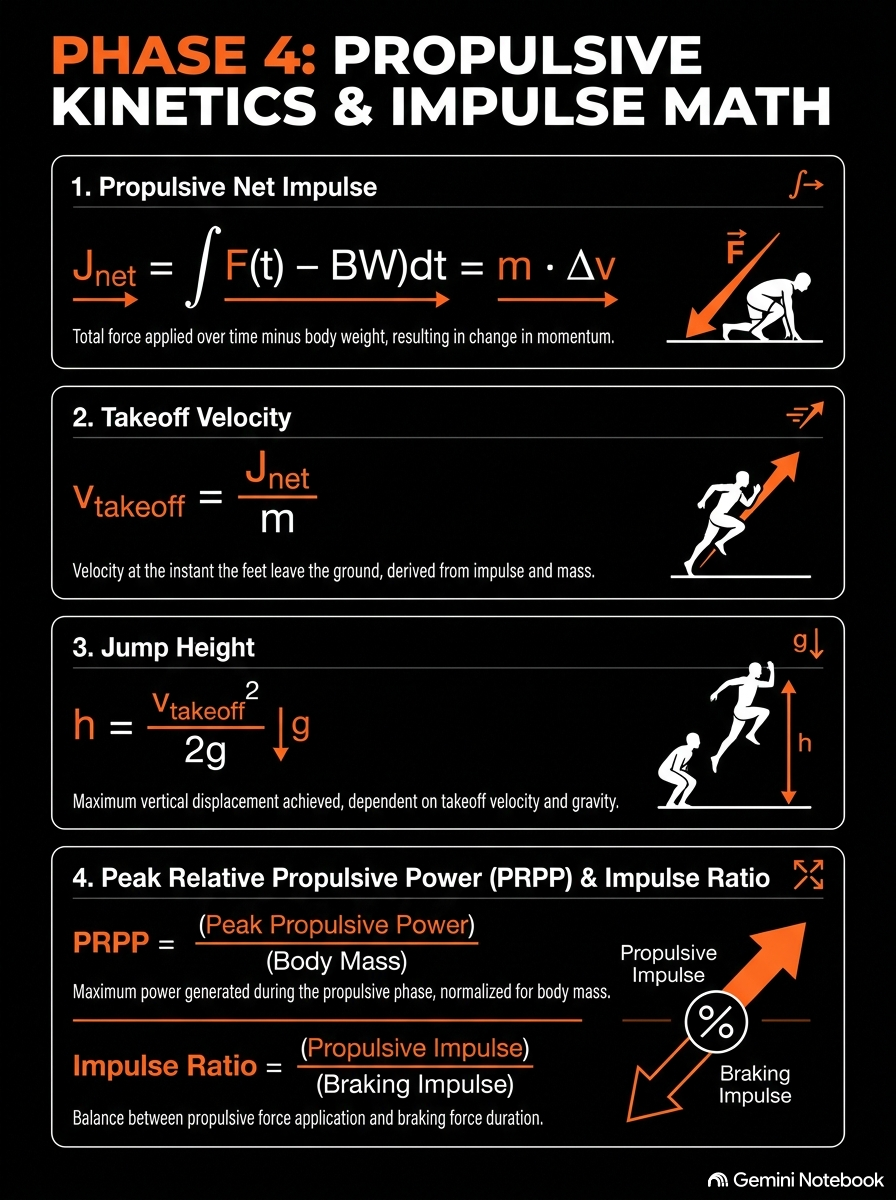
Mathematically, Propulsive Net Impulse is calculated by integrating net vertical force—vertical ground reaction force F(t) minus system weight (BW)—over the duration of the propulsive phase:
Propulsive Net Impulse (J_net): Integral of [Force(t) - Body Weight] dt from phase start to takeoff.
Impulse-Momentum Relationship: Propulsive Net Impulse = Mass × Takeoff Velocity.
Takeoff Velocity (v_takeoff): Propulsive Net Impulse / Mass.
Kinematic Jump Height (h): (Takeoff Velocity)² / (2 × g), where g = 9.81 m/s².
The Sequential Chain of Kinetic Events
Jump height cannot be analyzed in isolation because propulsive impulse is constrained by the kinetic events preceding it:
Quiet Phase: Establishes precise system weight in Newtons, setting the baseline for all net force integrations.
Unweighting Phase: The athlete unweights into a controlled descent, creating downward acceleration and velocity.
Braking Phase: The athlete decelerates downward velocity to 0 m/s. The net braking impulse generated during deceleration directly shapes the entry velocity into propulsion.
Transfer Point (Amortization): The transition window at zero velocity. High-efficiency athletes minimize amortization duration, effectively transferring momentum.
Propulsive Phase: Translates momentum into propulsive net impulse, establishing takeoff velocity.
3. Key Hawkin Dynamics Propulsive Metrics
To evaluate an athlete's concentric capability, practitioners examine several key metrics provided by dual force plate technology:
Peak Relative Propulsive Power (PRPP): Expressed in Watts per kilogram (W/kg), PRPP measures maximal instantaneous power output relative to body mass. It serves as a primary indicator of explosive concentric power.
Peak Propulsive Force & Average Propulsive Force: Reported in absolute terms (Newtons) and relative to body weight (N/kg), these metrics quantify the maximal and mean force applied during concentric extension.
Propulsive Net Impulse: The total net force integrated across the propulsive duration. This is the direct mechanical driver of vertical takeoff velocity.
Impulse Ratio (IR): Calculated as the ratio of Propulsive Net Impulse to Braking Net Impulse (Impulse Ratio = Propulsive Net Impulse / Braking Net Impulse). Impulse ratio evaluates how effectively an athlete converts deceleration impulse into concentric push-off impulse.
4. Bilateral Propulsive Asymmetry Analysis
Bilateral force plate systems measure left and right limbs independently throughout the force-time curve, providing critical insights into movement symmetry and neuromuscular strategies.
Asymmetry Metrics
Hawkin Dynamics tracks specific bilateral metrics during the concentric phase:
Left/Right Peak Propulsive Force Asymmetry (%)
Left/Right Average Propulsive Force Asymmetry (%)
Left/Right Propulsive Impulse Index (%)
Clinical and Performance Implications
A propulsive asymmetry exceeding a 10% threshold often flags underlying neuromuscular deficits, lingering joint restrictions, or compensatory movement strategies.
Compensation Mechanics: An athlete favoring one limb during propulsion may overload the dominant leg's triple extenders while under-utilizing the involvement of the contralateral hip, knee, or ankle extension.
Braking vs. Propulsive Asymmetry Tensions: It is common for athletes to exhibit symmetry during deceleration but reveal marked asymmetry during concentric push-off (or vice versa). An athlete with high braking symmetry who develops propulsive asymmetry may possess adequate deceleration capacity but lack concentric rate of force development or rate of muscle activation in the affected limb.
Return-to-Play Monitoring: In rehabilitation settings, tracking propulsive asymmetry over longitudinal microcycles provides an objective metric for confirming structural symmetry prior to full clearing for high-velocity sport demands.
5. Sport-Specific Kinetic Profiles
Force magnitude and phase duration in the propulsive phase vary significantly depending on the biomechanical requirements of an athlete's sport.
Primary Sport Movement:
MLB Shortstop: High-velocity sprint acceleration and lateral change of direction.
Pro Snowboarder: Sustained carving, land-and-ride transitions, and extended impulse loading.
Braking Strategy:
MLB Shortstop: Rapid deceleration capacity with a steep eccentric force surge.
Pro Snowboarder: Moderate deceleration over an extended displacement.
Propulsive Duration & Curve Shape:
MLB Shortstop: Short, explosive push-off time featuring a high peak force spike and rapid RFD.
Pro Snowboarder: Prolonged push-off window featuring a broad, plateaued curve with moderate peak force.
Kinetic Priority:
MLB Shortstop: Rapid momentum transfer for quick reaction.
Pro Snowboarder: High total impulse over a longer contact duration.
As illustrated by Hawkin Dynamics comparative profiles, an MLB shortstop relies on rapid force development to achieve quick vertical displacement in minimal time. Conversely, a professional snowboarder exhibits a broad, extended propulsive curve tailored to absorbed g-forces and sustained push-off demands across longer temporal windows.
6. Targeted Exercise Interventions and Programming
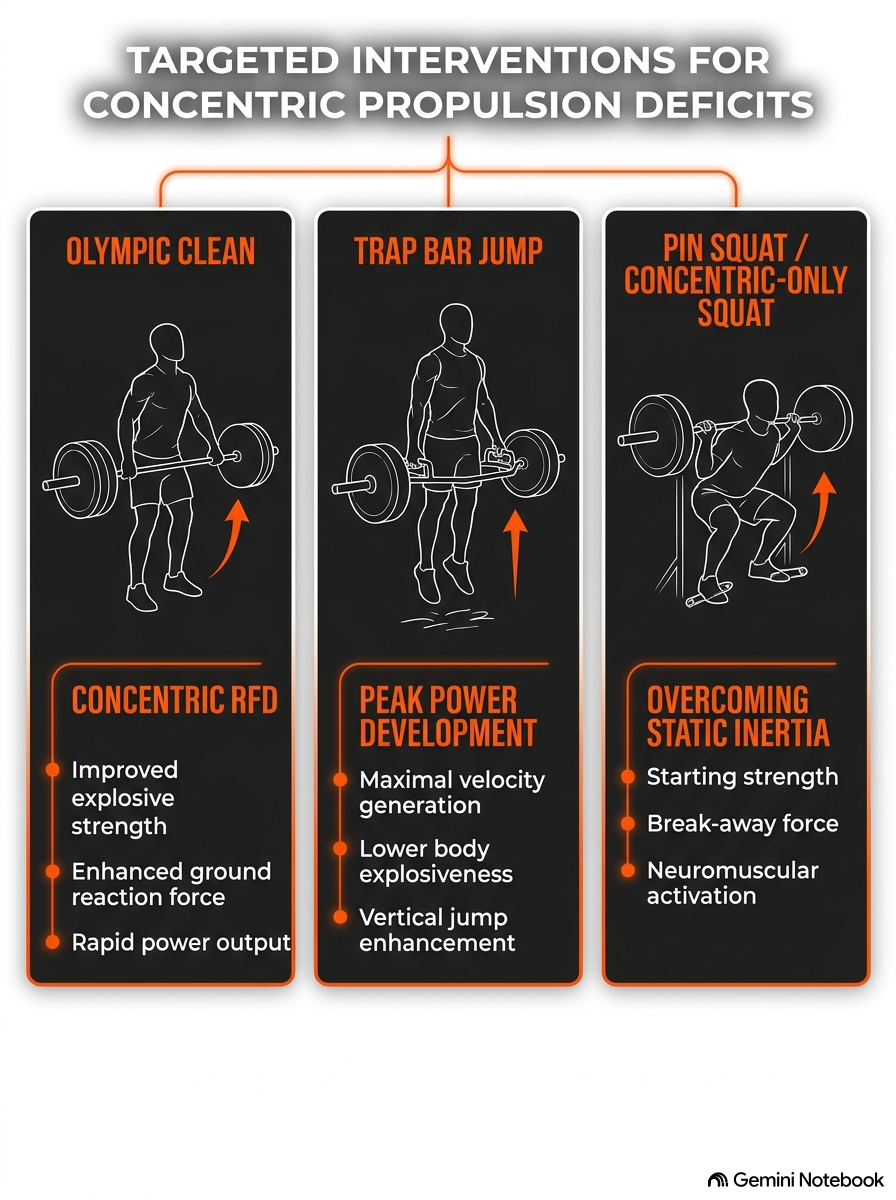
When force plate profiling reveals deficits in propulsive force, power, or concentric symmetry, strength and conditioning coaches can select training modalities that target the specific mechanical limitation:
1. Concentric Rate of Force Development Deficit (Low PRPP / Low Peak Force)
Intervention:Pin Squats or Concentric-Only Squats from a dead stop at 90-degree knee flexion.
Biomechanical Rationale: Eliminates the stretch-shortening cycle (SSC) assistance, forcing the athlete to rely entirely on voluntary concentric motor unit recruitment and rate of force development.
2. High Impulse / Dynamic Power Deficit (Low Propulsive Net Impulse)
Intervention:Trap Bar Jump Squats (loaded at 20–40% 1RM).
Biomechanical Rationale: Provides optimal external loading to maximize peak power output while allowing full triple extension acceleration through takeoff.
Biomechanical Rationale: Requires high-velocity concentric force production against heavy mass, demanding rapid triple extension of hip, knee, and ankle joints.
Biomechanical Rationale: Isolates the underperforming limb during concentric push-off, preventing the dominant limb from compensating during bilateral jumping tasks.
Summary for Performance Coaches
The propulsive phase is the ultimate concentric engine of the countermovement jump. By monitoring Peak Relative Propulsive Power, Propulsive Net Impulse, and Left/Right Propulsive Asymmetries, practitioners can move beyond basic jump height measurements to diagnose exact mechanical limitations, optimize exercise selection, and design targeted programs for athletic development.
Adapted from Hawkin Dynamics Countermovement Jump (CMJ) Playbook eBook v1.
what to read next
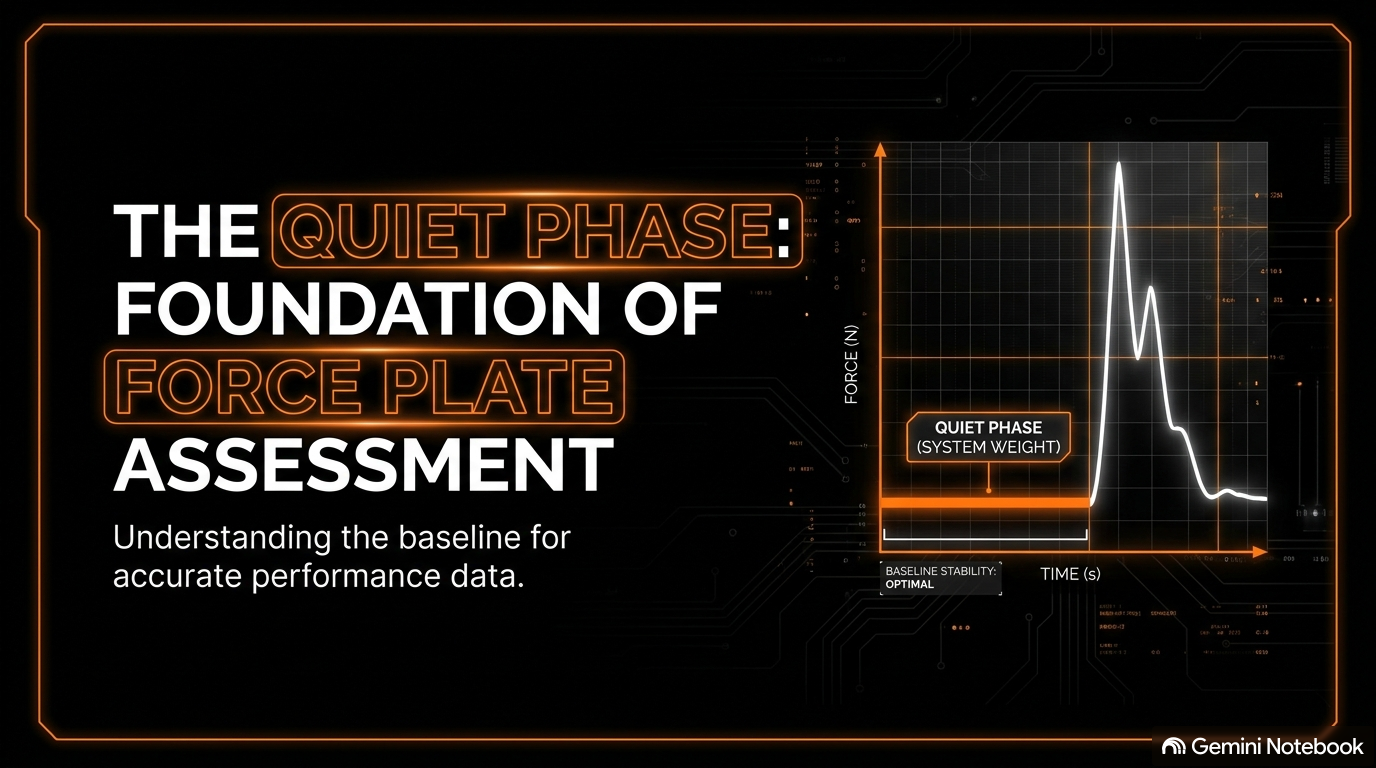
THE QUIET PHASE: WHY STANDING STILL IS THE MOST IMPORTANT PART OF FORCE PLATE TESTING
While explosive movement gets all the attention in countermovement jump testing, data accuracy depends entirely on the initial standing baseline. During the quiet phase, force plates measure an athlete’s system weight in Newtons, establishing the zero-point baseline required to calculate net force, velocity, power, and jump height. By enforcing a strict one-to-two-second motionless stance, coaches eliminate calculation errors, protect test validity, and gain a reliable passive tool for tracking body mass and recovery trends over time.
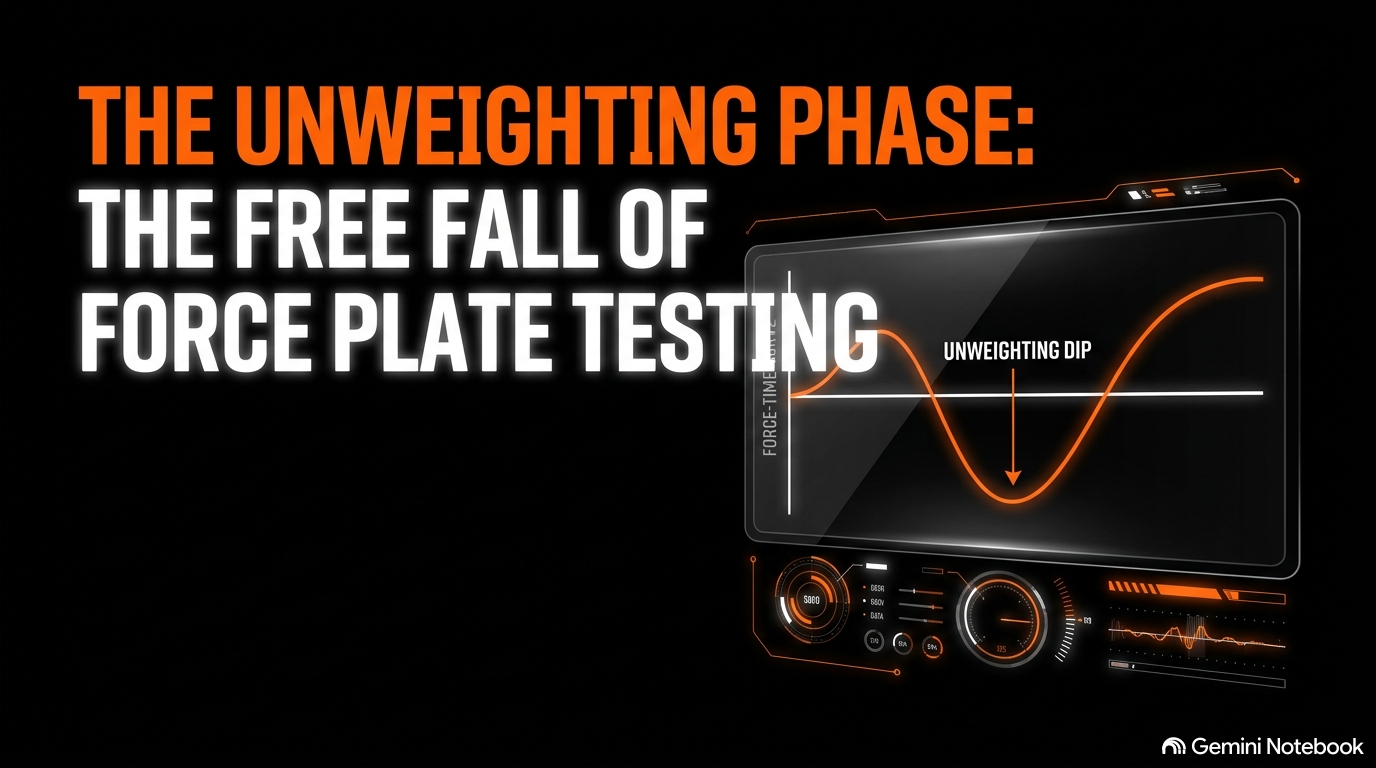
THE UNWEIGHTING PHASE: UNDERSTANDING THE FREE FALL OF FORCE PLATE ASSESSMENT
The unweighting phase initiates the countermovement jump as anti-gravity muscles rapidly relax, causing vertical ground reaction force to drop below body weight and allowing gravity to accelerate the athlete downward into "free fall." This rapid descent accumulates negative momentum and generates unweighting impulse, which, according to the equal area law of impulse physics, mathematically dictates the exact braking impulse required to decelerate the body. By understanding unweighting mechanics, practitioners can better evaluate an athlete's countermovement strategy and cue a fast, reactive drop that maximizes stretch-shortening cycle performance and downstream jump height.
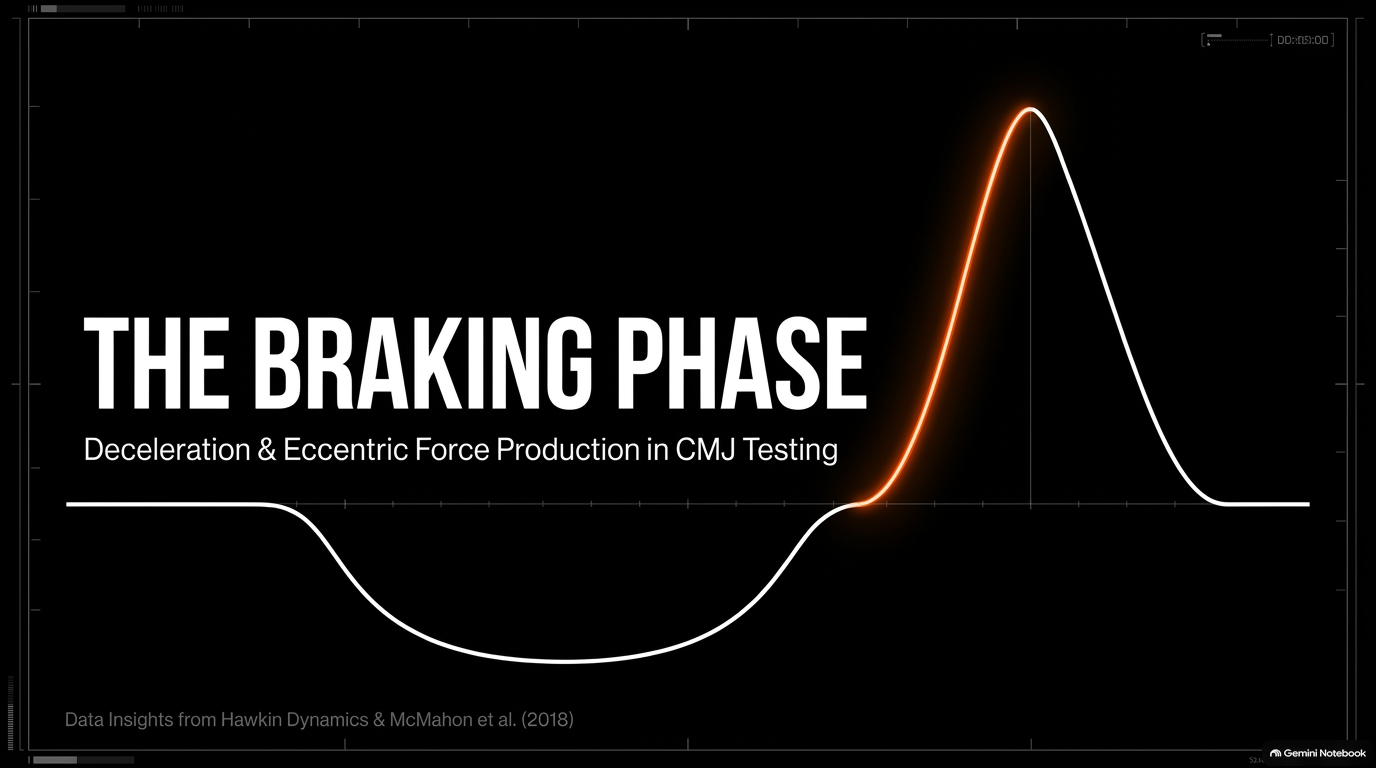
THE BRAKING PHASE: UNDERSTANDING DECELERATION AND ECCENTRIC FORCE PRODUCTION IN COUNTERMOVEMENT JUMP TESTING
The braking phase quantifies an athlete's eccentric deceleration capacity, beginning when ground reaction force surges back above System Weight and concluding when downward center-of-mass velocity reaches exactly zero at the transfer point. During this window, anti-gravity muscles actively generate eccentric force to arrest downward momentum and load the stretch-shortening cycle. Grounded in impulse physics, the net braking impulse must equal the preceding unweighting impulse, making metrics like peak braking force and eccentric rate of force development (RFD) critical for evaluating how efficiently an athlete decelerates mass before transitioning into concentric propulsion.